| Home | | | Items For Sale | | | Shops | | | Current Auctions | | | Auction Information | | | Auction Schedule | | | My Vervendi | | | Seller Registration | | | Bidder Registration (free) |
| Directory: Japanese: Tea Articles (1139) |
|
Auctions Shops Active In This Category
MAIN CATEGORIES
|
Gallery Rex
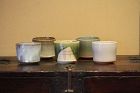
USD $60.00 These cups are made for the purpose for day use, using excellent glaze to be used for high class pieces by Master Sugimoto. Gohon, Funsei, Oribe, 2types of Madara.
The glaze of Madara-B type is made of ashes of tip part of
rice ear.
Size: 9.5cm(D)/ 8.0cm(H)
Gallery Rex
USD $60.00 These cups are made for the purpose for day use, using excellent glaze to be used for high class pieces by Master Sugimoto. Gohon, Funsei, Oribe, 2types of Madara.
The glaze of Madara-A type is made of ashes of stem part of
rice ear.
Size: 9.5cm(D)/ 8.0cm(H)
Gallery Rex
USD $60.00 These cups are made for the purpose for day use, using excellent glaze to be used for high class pieces by Master Sugimoto. Gohon, Funsei, Oribe, 2types of Madara.
Size: 9.5cm(D)/ 8.0cm(H)
Gallery Rex
USD $60.00 These cups are made for the purpose for day use, using excellent glaze to be used for high class pieces by Master Sugimoto. Gohon, Funsei, Oribe, 2types of Madara.
Size: 9.5cm(D)/ 8.0cm(H)
Gallery Rex
USD $60.00 These cups are made for the purpose for day use, using excellent glaze to be used for high class pieces by Master Sugimoto. Gohon, Funsei, Oribe, 2types of Madara.
Size: 9.5cm(D)/ 8.0cm(H)
Kodo Arts
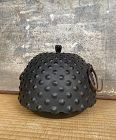
$650.00 Very art deco 'arare' (hail) style iron tea ceremony 'kama'. Ca. 1950. Excellent condition. Ask for shipping quote.26cm tall x 9 cm wide.
Momoyama Gallery
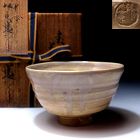
sold Remarkable Wabi-Sabi Shino Chawan made by one of the best potters in Japanese history - Seto master Kato Shuntai (1885-1961). This tea bowl was made over 100 years ago and it comes with the originally signed wooden box of the artist. His real name is Kanae KATO. He was born 1885 as the third son of Shunsen KATO. In 1907 he established a branch family, named himself Shuntei and became the first generation...
Momoyama Gallery
$450.00 Refined simplicity, soft glaze and distinctive crackle patterns - what a beauty! Perfect Hagi Chawan by one of the best Hagi artists in history - the 10th Saka Koraizaemon (1890–1958). The Japanese Emperor and the loyal families officially ordered his works regularly. In addition, he was recognized as the human treasure with valuable technique (the old system of Japanese Human National Treasure) from the Japanese government...
Momoyama Gallery
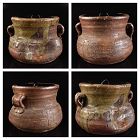
sold A beautiful example of a mid Edo Period (1603 - 1868) Shigaraki Mizusashi (fresh water container for the tea ceremony) displaying classic Shigaraki markings. Based on Momoyama and early Edo Shigaraki archetypes, sports a rugged purpose with a reliance on tradition while not being a slave to it. In a tea room or on a shelf this piece of ceramic art has a commanding aesthetic presence...
Japanese : Tea Articles : Pre 1980
item #1500182
(stock #04445)
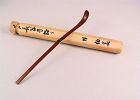
The size Chashaku: 7 1/8” L x 3/8 “ Widest.
The size Bamboo Case: 8 1/2” Long. Size of Kiriwood case: 9 3/8” L. This is beautiful fine Japanese Vintage Bamboo Chashaku( Tea Scoop) with the finish of Susu-take. Susu-take is bamboo piece been smoked and aged used from old Japanese Kayabuki house ceiling by soot and natural aged over 100 years old. Chashaku has nice contour shape. It came with Bamboo case as well as Kiri (paulownia) wood case...
Japanese : Tea Articles : Pre 1970
item #1500180
(stock #04457)
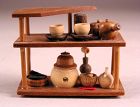
The size Shelf: 2 1/4” L x 1 1/8” W x 1 13/16” H
The size of Tea Bowl with Chataku 5/16” Dia This is wonderful Japanese Vintage Miniature Chado Set The whole set are made by finely crafted Japanese wooden pieces Amazingly detail works on each Tea Ceremony Utensil works The age of set from 1970-75. It is made in Kyoto Japan. The item on the bottom shelf, left to right. Charcole tray, Chagama, Tea Ground bowl, Chashaku(tea scoop) and covered bowl...
Gallery Rex
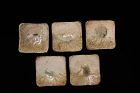
USD $350.00 This pieces were made about 30years ago and not used. They were fired for 10 days in anagama with only red pine fire woods. Thy were not used with artificial glaze, Ashes of red pine trees turned to very beautiful green glass just like scenery of natural.
Size: 15.0cm (S)/ 2.3cm(H)
5 pieces set, however each piece is available
Accessary(set): wooden box signed by artist.
Gallery Rex
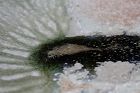
USD $350.00 This piece was made about 30years ago and not used. It was fired for 10 days in anagama with only red pine fire woods. It was not used with artificial glaze, Ashes of red pine trees turned to very beautiful green glass just like scenery of natural.
Size: 37.0cm (D)/ 5.0cm(H)
Accessary: wooden box signed by artist.
Momoyama Gallery
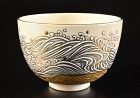
sold A truely rare example of an Kiyomizu Ukibori (浮彫) tea bowl, made around 70 years ago. The bowl is artfully decorated with a relief based on scenes from the “Great Wave of Kanagawa”, the famous woodblock print by Hokusai. The waves were applied and painted using the old traditional ukibori (浮彫) technique. Ukibori (浮彫) is a Japanese decorative technique often applied to ceramics, wood, and other materials...
Dragon's Pearl
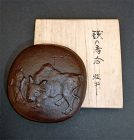
$500.00 A very attractive and fine cast iron incense container (kogo) for tea ceremony decorated with a motif from the Ten Ox-herding Pictures of Zen Buddhism. Inside covered in gold. Signed by Suzuki Morihisa (1920–1981), a 14th generation of cast iron-makers from Morioka who later taught at the Academy of Fine Arts in Tokyo. A frequent exhibitor at the Nitten. With original signed kiri-tomobako. H 3 cm, D 7,2. Condition: Perfect.
Conservatoire Sakura
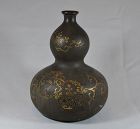
$1,800.00 Shaped like a double gourd very elegant, this tokkuri is in lacquered tin. The decoration is in "Takamaki-e" lacquer (sprinkled) with gold and pigmented with red and black. Japanese lacquerers did not use tin as a support for their works because of the lack of porosity of the metal. Such objects are therefore very rare...
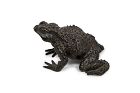
Okimono bronze sculpture of a toad.
The toad or the frog (kaeru) is associated with good luck and wealth. Kaeru means both
“toad” or “frog” and “to return home” in Japanese. This meaning is due to the toad’s
ability to return each year to the pond of its birth. A gong in the shape of a toad can
sometimes be used as a door hammer or to protect house.
Japan – Meiji era (1868-1912)
Width: 4.3 in (11.5 cm) – depth : 4.7 in (12.5 cm) – height: 2.4 in (6.8 cm)
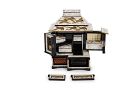
Miniature tea house with a crane and bamboo motif in black and gold takamaki-e
lacquer on a rankaku (eggshell inlay) base. It has several compartments and trays on
the roof, walls and base. Walls opening in the center with a pewter clasp.
Japan – Meiji era (1868-1912)
Height: 13 cm – width: 14 cm – depth: 10 cm
|