| Home | | | Items For Sale | | | Shops | | | Current Auctions | | | Auction Information | | | Auction Schedule | | | My Vervendi | | | Seller Registration | | | Bidder Registration (free) |
| Directory: Japanese: Tea Articles (1139) |
|
Auctions Shops Active In This Category
MAIN CATEGORIES
|
Kyoto Ceramics and Fine Art
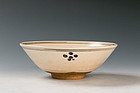
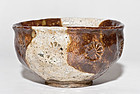
Sold, Thank You! This lovely plum patterned chawan (umebachi) is done in a classic style known as e-Gorai (“e” meaning picture and “Gorai” meaning Korean). This classification is somewhat of a misnomer as the style is said to have first developed at China’s Cizhou kilns in early Ming—only later being widely copied and popularized in Korea. e-Goriai wares first made an appearance in Japan by way of Korea at the end of the 16th century and have been highly appreciated among tea enthusiasts to this day...
Momoyama Gallery
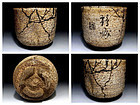
$1,400.00 We kindly like to offer you a very unique tea bowl, made around 1800. Very sophisticated Karatsu Chawan, perfect in form and shape. It presents a real wabi sabi aura with its fantastic lacquer-silver repair and its antique Japanese characters on. The 1st one seem to be Sakura (Cherry), and the 2nd probably Umi (ocean), but they are hard to read. Size: 10 cm height x 10,5 cm in diameter. Shipping included
Momoyama Gallery
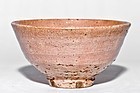
sold Is there a tea ceremony connaisseur, who does not like to have a true Edo Ko-Hagi Chawan with beautiful loquat color?
Take a look on this rounded wan-shaped bowl. The light, sandy clay with enclosures is expertly thrown. Including the foot ring the bowl is covered with a mixed feldspar and ash glaze. The light iron oxide in the clay produded a beautiful loquat color known from Korean Ido chawans...
Momoyama Gallery
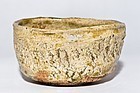
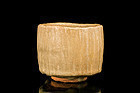
sold Momoyama to early Edo period made, little distorted half cylinder ki-Seto (yellow Seto) chawan with a great wabi-sabi atmosphere, rarely seen on ki-Seto items. Ki-Seto is said to have been the outcome of the attempts of potters to recreate Chinese celadon wares. A fortunate mistake, for a new ware was born. The ash glaze looks like deep-fried tofu and has been given the name aburaage-de. Almost all Ki-Seto wares are serving utensils - exept some few tea bowls...
Momoyama Gallery
sold Elegant and sophisticated Shino Chawan, wonderful dialogue of brown and cream Shino crackle glaze, made during the early to the mid Edo period. It is decorated outside with the Imperial Seal of Japan, the Chrysanthemum Seal and inside with two stars. This design I have never seen on other tea bowls before. No cracks or repairs, just aesthetic inborn kiln cracks. Gorgeous and rare. Box and shipping included. Size: 2,8'' height and 5'' in diameter
Momoyama Gallery
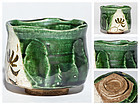
Sold Here is a real beauty. Perfect in form, shape and design: Ao-Oribe (Green Oribe) Chawan from the early stage of Edo period. Little distorted half cylinder shaped (kutsugata) tea bowl with slightly flaring mouth made of light, unrefined Mino clay. The expertly thrown body was trimmed with a potters knife and covered with the typical green copper oxide glaze inside and outside...
Momoyama Gallery
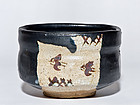
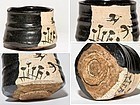
sold Little distorted half cylinder shaped (kutsugata) tea bowl - made of light, coarse, unrefined Mino clay. The expertly thrown body is covered with the typical, glossy black iron oxide glaze inside and outside, leaving 2 unglazed 'windows' on opposite sites. One 'window' is decorated with ivy or vine leaves. The other 'window' shows flying birds in iron oxide glaze which has been covered with a clear ash and feldspar glaze. This is a typical Momoyama Era design...
Momoyama Gallery
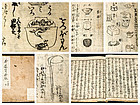
sorry sold Exceedingly rare early text on the Japanese Tea Ceremony - 210 years old. The only book of the tea ceremony in our family collection. Profusely illustrated with woodblock images depiciting a wide variety of tea accoutrements. A beautiful example of Japanese life and expression, and an exquisite addition for the discriminating collector of Japanese antiques and Tea Ceremony items. Such old books about the tea ceremony are mostly hold in museums...
Momoyama Gallery
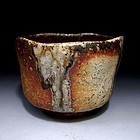
sold Rough and heavy Hagi Chawan, over 100 years old (Meiji Period), with an expressive crackle glaze. Aesthetic inborn kiln cracks make this chawan so special. No damages or repairs. The signature chip located on the bottom (unknown potter to me) is a local tradition from the Edo period when potters would deliberately disfigure their wares in order to sell them to merchants instead of presenting them as gifts to the Môri clan...
Momoyama Gallery
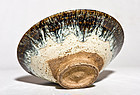
sold Ch¨sen Karatsu (³¯õrÌƽò) Chawan with a fantastic vivid glaze. It dates from the late Edo Period, no cracks, no repairs. This traditional style was introduced by one or more potters brought from the Joseon Dynasty during the Japanese invasions of Korea. It features a black glaze placed under a white glaze which has been fired with straw. The two glazes run together and give a feeling of opposites. The old box and shipping are included...
Kyoto Ceramics and Fine Art
Sold, Thank You! The Mino region of Japan has been renowned for centuries for producing high-quality Shino, Oribe, Seto-guro, along with the style shown here, ki-Seto, or “yellow” Seto. The creator, Hori Ichiro, is one of the most acclaimed among Mino potters, tirelessly producing splendid works while continuing to use traditional methods passed down from other great potters before him...
Momoyama Gallery
sold Very beautiful Kuro Oribe Chawan of early Edo period: Only very little distorted half cylinder shaped (hanzutsu) tea bowl made of light, coarse, unrefined Mino clay...
Kyoto Ceramics and Fine Art
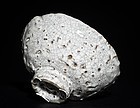
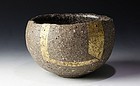
Sold, Thank You! An ancient technique known as “haito” in Japanese was used to give this piece its distinctive look. Thought to have originated in neolithic times and commonly used during the T’ang and Song dynasties in China, an excess of fuel is added at the very end of firing which causes a thick layer of grey ash to adhere to the outside of the vessel. Below the ash glaze of this piece is a yellow amber reflective coating that shows through in areas giving it an almost imperceptible glittering effect ...
Momoyama Gallery
Sold SPECIAL OFFER Today we like to present you one of our Shigaraki Chawans, roughly pottered and burned in a true wabi-sabi way around the mid 19th. cent. Highly recommanded for lovers of Japanese aesthetics. There is an old kiln mark and, rarely seen - 3 holes inside the foot. Great display piece. The local sandy clay from the bed of Lake Biwa has a warm orange color, and makes very durable pottery. This clay characterizes Shigaraki ware. The ceramics have ...
Momoyama Gallery
sold Here is the next Japanese rare Momoyama Period collectible: Slightly distorted cylinder shaped (hanzutsu) tea bowl made of light, fine, unrefined Mino clay. Shape and style make it appear contemporary with the late Oribe bowls. The expertly thrown body is covered with the typical black oniita engobe inside and outside - with the exception of the bottom - over which a white, feldspatic Shino glaze has been poured. Just the foot ring and its immediate surrounding was left ...
Kyoto Ceramics and Fine Art
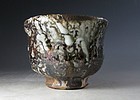
Sold, Thank you! This striking chawan is a fine example of Oni Shino (carbon trap and natural ash glazing) that Tsukigata is so well-known for. Coining the term in the mid-50’s after countless failed experiments—which ultimately culminated in the discovery of this unique style of pottery—“Oni” translates roughly to demon or ogre. Fired at extreme temperatures for days in an anagama, the iron in the clay and in the glaze fuse, drip, and coalesce—while at the same time blending with the molten ash of t...
Zentner Collection
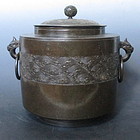
SOLD Antique Japanese bronze mizusashi with lid, decorated with waves. The mizusashi is a vessel used during the Japanese tea ceremony to hold water. The body of the container has a dragon's head on each side with a bronze ring. The lid is decorated with a band of waves, the handle is rounded. Meiji period, 1868-1912. True original bronze Vessal
It measures 10" tall with lid, 6.5" wide at opening 11" at widest point (dragon to dragon handle).
Kyoto Ceramics and Fine Art
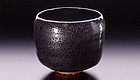
Sold, Thank You! Attractive design, refined form, sensational glazing—this yuteki chawan by Morikazu Kimura would make a fine addition to any collection of Japanese contemporary ceramics.
Born in Kyoto in 1921, Morikazu Kimura took up the family tradition of potting from a very young age and spent much of his time researching and perfecting the Tenmoku style. In 1947 at the age of 26 he set up his own kiln in the exclusive potting district of Gojo-zaka and achieved much success. Later, in 1976, h... |