| Home | | | Items For Sale | | | Shops | | | Current Auctions | | | Auction Information | | | Auction Schedule | | | My Vervendi | | | Seller Registration | | | Bidder Registration (free) |
| Directory: Japanese: Tea Articles: Pottery (615) |
|
Auctions Shops Active In This Category
MAIN CATEGORIES
|
Momoyama Gallery
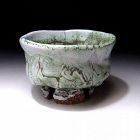
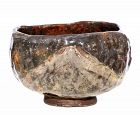
sold Mint Oni-Hagi masterpiece chawan with notched foot by star potter Seigan Yamane. This extraordinary tea bowl is covered by wonderful different shades of white and light green glaze. In my opinion it is the one of the most aesthetic chawans that he made. The seal of the artist is stamped on the bottom. Seigan Yamane was born in 1952, and started making Hagi ware in 1987...
Welcome To Another Century
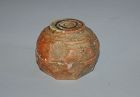
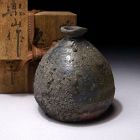
$500.00 Fantastic kogo, box for keeping incense, in the shape of a slightly abstracted wish-granting jewel, hoju no tama.
Brown stoneware with typical white inclusions, greenish brown ash glaze on top. Shigaraki stoneware. Japan, late Edo period, 19th century. H 2 x L 2.25 x W 2 inches Minimal traces of usage commensurate with age and usage. Overall in excellent condition Comes with kiri-wood tomobako with inscription...
Momoyama Gallery
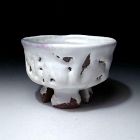
sold Mint Oni-Hagi masterpiece chawan with notched foot by star potter Seigan Yamane. This extraordinary tea bowl is covered by wonderful different shades of white glaze and a few shades of purple on brown pottery. In my opinion it is the one of the most aesthetic chawans that he made. The seal of the artist is stamped on the bottom. Seigan Yamane was born in 1952, and started making Hagi ware in 1987...
Zentner Collection
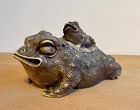
SOLD Unusual Japanese incensor of two Japanese toads made from Izushi Yaki pottery technique. Depicting a large toad with a smaller baby toad resting on top. Smoke rises from the inner chamber an rises and vents from each of their mouths. Beautiful original patina consisting with age. Overall very good condition.
Izushi is a town that continues on from the mythical era. Today it is a castle town popular for its nostalgic atmosphere of old Japan...
Momoyama Gallery
$695.00 One of the most attractive chawan by Ohi Chozaemon VIII (Choraku) (1902-1991) I have seen. It was made around 30 years ago in the style of Raku. The Chozaemon family of potters has been associated with the world of the Japanese tea ceremony since the 17th century. The Chozaemon lineage started with Hodoan (1631-1712), apprentice to the fourth heir of the Raku family of potters...
Momoyama Gallery
sold Sophisticated Bizen Tokkuri (Sake flask) made by one of the best artists of Bizen-yaki, the 2nd. Rakuzan Fujiwara (1910-1996). The Tokkuri was made 50 years ago and is still in mint condition. The surface is covered with natural glaze created with ash...
Zentner Collection
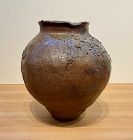
$3,700.00 Tokoname jars were made by piling coils of clay, smoothing the interior and exterior surfaces, and allowing the clay to dry before adding another section. The wide rim and mouth were then formed on a potter’s wheel and added to the top of the jar. The small base allowed the vessel to stand safely on a narrow step on the steep slope of a rising kiln floor; such kilns were built into the side of a hill and used wood for firing...
Momoyama Gallery
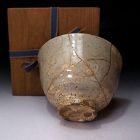
sold This is a unicum! We like to offer you one of the highlights of our collection. A very fine and aesthetically pleasing Karatsu Tea Bowl from the early stage of the Edo Period (1603-1868). It has one of the most beautiful Kintsugi repairs we have ever seen. A mixture of lacquer and gold powder showing a traditional Karakusa pattern. There is no comparable bowl - a real unicum. The 'kara' of Karakusa means 'China', while 'kusa' means 'plant'...
Momoyama Gallery
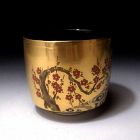
sold A shiny golden Kyo-yaki tea bowl in mint condition made by the great Kyo artist Eika Miyaji 25 years ago. Red and white plum trees are hand painted on the body. This is definitely the most beautiful work of Eika Miyaji we have ever seen. The seal of the potter is stamped on the bottom. His work was often published in great books (please refer to the last picture) No chips or cracks - mint. Size: 9 cm height x 10,1 cm in diameter. Free shipping
Momoyama Gallery
sold We like to offer you a sophisticated Hagi Chawan, made during the early Meiji Era (1868-1912), perfectly thrown and highlighted with an old gold restoration, a fantastic gintsugi (kintsugi) which makes our Hagi tea bowl so valuable and outstanding. It comes with a good Japanese wooden box. Size: 8,2 cm height x 12,9 cm in diameter. Free shipping.
Momoyama Gallery
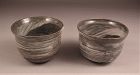
sold A magnificent Kuro Oribe Chawan of larger size and wonderful shape, made during the end of the Edo period (1615-1868). This kind of shoe-shaped bowl is called kutsu-chawan... The size of Tea Cup: 3 1/8" Dia x 2 1/4" High. The pair of Japanese Hakeme Tea Cups by 1st Kuze Kyuho (1874-1947). It is finely made with brownish earthen clay...
Momoyama Gallery
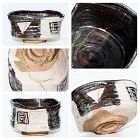
sold A real piece of art: Shino-Oribe Tea Bowl from the early Edo Period (around 1620, early 17th century). It is a shoe shaped Kutsugata Chawan covered with a whitish Shino-Oribe glaze over an iron oxide engobe in two quarter sections, where a triangle has been scratched into the dark engobe. The other two opposite quarters show a decoration of two squares in the style of mimasu - three squares. The roughly cut foot ring and its surrounding show the typical little refined Mino clay. Th...
Momoyama Gallery
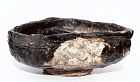
sold We continue our presentation of Ohi chawan (Ohi tea bowls) with yet another sublime vessel, a true eye-catcher made at the end of the Meiji Period around 1910. It's a unique Ohi Chawan which seems to be a kuro Raku bowl, but it isn't. With its sophisticated shape and its mesmerizing play of predator pattern inside its outstanding. Ohi ware is indeed closely related to Raku; the first Ohi potter was the son of Raku III, Donyu, and apprenticed to the fourth Raku master, Ichinyu. In Ka...
Momoyama Gallery
sold Sophisticated Hagi Chawan by Living National Treasure Miwa Kyusetsu X (Kyuwa) (1885-1981) with warekodai made 70 years ago. Many of Miwa's chawan have a split cross footring called a warekodai that was favored by busho chajin (warrior tea men); it traces its origins to Korean chawan. This chawan has a rare warekodai with only one split. Miwa Kyusetsu X was a member of the group around Rosansin an Arakawa, which revived the momoyama ceramic. He is a legendary figure, and r...
Momoyama Gallery
sold Perfectly shaped Kuro Raku Chawan of Nitten Exhibition Potter Kiraku Kuzu with a beautiful jet black glaze. The Chawan was made 30 years ago. It is in mint condition and comes with its originally signed and sealed wooden box and an appraisal of the famous Japanese Daitokji Temple, which makes this Chawan very special. No chips or cracks. Size: 8,5 cm height x 12 cm in diameter. Free shipping.
Momoyama Gallery
sold From our family collection of Japanese art from Living National Treasures: perfectly shaped Bizen Chawan from legendary Kaneshige Toyo (1896 - 1967). It was made 55 years ago and is in absolutely great condition. Born into the Kaneshige family, one of the six kilns of Bizen, as the son of wakigama-style potter Kaneshige Baiyo, Toyo was trained by his father from early childhood and became adept at pottery techniques, with handicrafts and engraved ornaments being his particular speci...
Momoyama Gallery
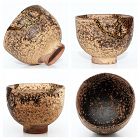
sold Here is magnificent example of the beauty of Raku ware, a pottery tradition born more than 400 years ago in the ancient Japanese capital of Kyoto, from the collaboration between great tea master Sen Rikyu (1522-1591) and a potter named Chojiro ( - 1592), the forebear of the great Raku family of potters. Sublime half cylinder shaped (Hanzutsu) tea bowl with a rounded brim, in the typical hand built style of the Raku family. The body is fully covered with a white engobe before the red... |