| Home | | | Items For Sale | | | Shops | | | Current Auctions | | | Auction Information | | | Auction Schedule | | | My Vervendi | | | Seller Registration | | | Bidder Registration (free) |
| Directory: Japanese: Netsuke (297) |
|
Auctions Shops Active In This Category
MAIN CATEGORIES
|
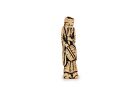
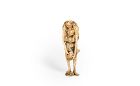
Netsuke representing Jurôjin standing, he is holding his long beard his left hand and
in his right hand he holds a fan. He is wearing a long robe decorated with cloud
motives and a traditional hat
Jurôjin is a god of longevity and among the Seven Gods of Happiness, according to the
Taoist beliefs. He is depicted as an old man with a long white beard, wearing a high
hat and a long robe. His attributes are the fan and the pilgrim stick...
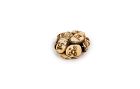
Ivory manjû netsuke featuring a Noh masks group. Among the eleven masks, there
are Okame, Hannya, Shôjo, Hyottoko, Oni, and Obeshimi.
The multiple masks, delicately carved and the significant spacing between them,
revealing the interior of the netsuke...
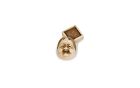
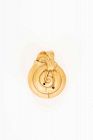
Ivory netsuke with the Noh mask of Okame and a masu rice box.
Okame, also known as Suzume, is the divinity of cheerfulness and good humour.
Masu are traditional square measuring containers made of cypress wood, used for
measuring foodstuffs such as rice, or for drinking sake.
Signed Mitsuyuki (光之).
Japan – Meiji era (1869-1912)
Height: 0.7 in / 1.7 cm – width: 1.1 in / 2.8 cm – depth: 1.2 in / 3 cm
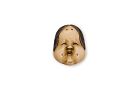
Ivory Netsuke of Okame Noh mask, signed Hikari (光) on the back.
Okame, also known as Otakufu, is a popular figure in Japanese folklore. She is often
depicted as a cheerful, jovial woman with a round, smiling face, plump cheeks and
small, squinty eyes. Okame is considered a symbol of good fortune and happiness...
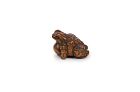
Netsuke of a wooden toad with its throat swollen. Made entirely in boxwood, the skin
is treated with detail, the naturalistic pause suggests that the toad is croaking, the
smooth texture of the goiter contrasts with the uneven sensation on the rest of the skin.
The facial expression is very amusing and mimics the one of a real toad.
The toad or frog (kaeru) is associated with good luck and wealth. Kaeru means both
"toad" or "frog" and "to come home" in Japanese...
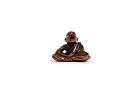
Boxwood netsuke of a seated professional sneezer depicted as an old man with his
right hand raised, holding an ivory stick to tickle himself. His head is slightly raised,
his eyes practically closed and his mouth wide open, signs that he is about to sneeze.
Himotôshi underneath, one hole larger than the other...
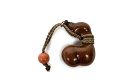
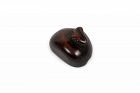
Netsuke made from a natural lacquered calabash.
Curved around itself, it has a main bulb at the bottom and a second smaller bulb below
the opening. It is narrowed in the middle, where the silk cord is attached. Wooden
stopper with red wax and coral ojime...
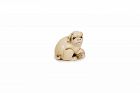
Ivory netsuke of a dog, right front paw resting on a shell.
Black eyes in horn.
Japan–Late Edo period (1615-1868) or Meiji era(1868-1912),19thcentury Width:1.2 in(3.5cm)–depth:0.8 in(2.5cm)–height:1.2 in(3cm)
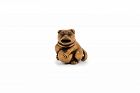
Boxwood netsuke representing a puppy with is eye made of buffalo horn, he weras a collar and hold a ball in its paws
Underneath, a signature by Shin ou Asa (晨).
Japan – Edo period (1603-1868)
Height : 4 cm – Width: 3 cm – Depth: 4 cm
Small sculpture depicting two yokai, monsters or spectres common in japanese folklore, known
as Ashinaga-Tenaga, « Long legs – Long arms », holding a fish...
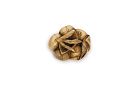
Small sculpture depicting six fruits, an eggplant, a pomegranate, two kakis, a peach and a
yuzu. A small snail is represented climbing the leaves on the top of the object.
The eggplant, while being a symbol of death, is also an auspicious one by its homonymy with
the verb accomplish or realize, both being said “nasu”. The pomegranate is a symbol of fertility
in eastern Asia, and the kaki a fruit for festivities related to luck for the upcoming year, being
a winter fruit...
GALERIE TIAGO
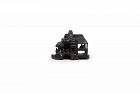
Sold Wooden netsuke depicting a nobleman surrounded by two courtiers in a pavilion surrounded by pine trees. At the back, figures are going about their business.
Signed under the base Seizan (生山).
Japan, Nagoya – Late Edo period (1603-1868), first half of the 19th century
Height: 1.2 in / 3.8 cm – width: 0.8 in / 2.5 cm – depth: 1.6 in / 4.8 cm
Boxwood netsuke of two chestnuts, one smaller on
top of the larger. Chestnuts, found all over Japan, are considered a symbol of victory and a good omen.
Japan–Meiji era(1868-1912)
Width:2 in (5 cm)–depth:0.8 in (2.8cm)–height:1.6 in (4cm)
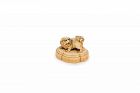
Ivory netsuke of a guardian lion, komainu in Japanese or shishi in Chinese, with golden eyes. Resting on its front paws, its head is turned backwards on a four-lobed base. The komainu is inspired by the Chinese guardian lion shishi, which dates back to the Tang dynasty (581-618). Supposed to ward off evil, it appears on both sides of doors
and portals in Shinto shrines and Buddhist temples
Mastromauro Japanese art
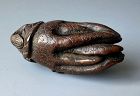
EUR €2,400 An ivory netsuke depicting a snail, with horn details. This work captures the moment the snail emerges from its shell.
Period: Meiji late 19th century.
Dimensions: 2.2 x 3.9 x 3.2 cm.
Condition: Excellent. There are natural ivory streaks, typical of the material.
Zentner Collection
$1,600.00 Antique Japanese Boxwood Buddhas Hand Netsuke. Hand carved with great detail. No losses, original condition. Tie loop carved through on stem of the citron.
In Japan, this citron is known as “bushukan” and is a popular gift to a household at New Year's as it symbolizes good fortune. Age: Meiji Period (1868 - 1912) : Dimensions: 2 1/3" long x 7/8"
Mastromauro Japanese art
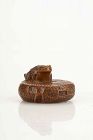
EUR €2,000 A boxwood netsuke depicting a toad climbing a circular stone millstone. The toad's wrinkled skin is meticulously engraved to create a realistic appearance. The netsuke has a shiny patina with varying shades that enhance the natural beauty of the material and the quality of the carving.
Period: Edo 19th century
Dimensions: 2.4 x 3.9 x 3.9 cm.
Condition: Excellent.
Mastromauro Japanese art
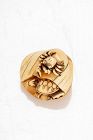
EUR €1,300 An ivory netsuke depicting a closed shell with a crab, whose legs are carved with great precision, highlighting the joints and the small details of the claws.
Inside the shell, a turtle is carved in a crouched position, with its head, legs and tail protruding from its shell.
Period: Edo 19th century.
Dimensions: 2.2 x 4 x 3.6 cm.
Condition: Excellent.
|