| Home | | | Items For Sale | | | Shops | | | Current Auctions | | | Auction Information | | | Auction Schedule | | | My Vervendi | | | Seller Registration | | | Bidder Registration (free) |
| Directory: Japanese: Metalwork (849) |
|
Auctions Shops Active In This Category
MAIN CATEGORIES
|
Zentner Collection
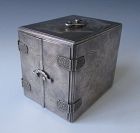
$4,000.00 Antique Japanese small kodansu (jewelry box) made of silver and incised with fans decorated with waves, birds and flowers. Two hinged doors open to reveal 3 small drawers, lacquered black and lined with green velvet.
Age: Meiji Period (1868-1912) Dimensions: 4 3/4" high x 4" wide x 5 1/4" deep
Kodo Arts
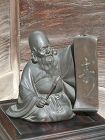
Price on Request Superb bronze scholar holding a caligrapgy brush and an undulating scroll with the character `Kotobuki` (congratulations) in faded silver. The folds of the robe and face and brush are of the highest bronze craftsmanship. Signed on the bottom "Shuro" one of the leading craftsman of the late Taisho Period C.1920. Roughlt 7" tll by 5" wide. Table included. Excellent condition. Ask for shipping quote.
Zentner Collection
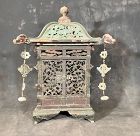
SOLD A beautiful original large Buddhist temple sitting lantern called Koshi Tsuridoro. These lanterns are placed in front of the entrance to the temple itself. The verdigris copper and wood construction is decorated with 8 panels of scrolling arabesque designs of lotuses. The front pair panels are hinged and they are secured with a lock and sliding flat pin.
Zentner Collection
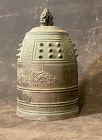
SOLD An antique Japanese bronze Buddhist temple bell called Bonsho with a carrying handle depicting diverging dragon heads called Ryuzu. The upper protrusions called Chi or Nyu improves the resonance of the sound when struck. Two opposing striking panels called Tsuki-za is the point on the bell where the best and longest sound is achieved. A bell of this size was hung in a small temple to summon the monks to prayer...
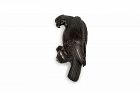
Hanging bronze (銅掛斜生, dô kakenanaike) depicting a hawk, placed on a branch. The inside is hollow so a bouquet a flowers can be put inside and thus, serve as an ikebana vase.
Ikebana or Ka-do (the way of flowers) is a traditional Japanese art of flower arrangement. Contrary to Western floral art, ikebana does not aim to emphasize only the beauty of flowers and the harmony of colors...
GALERIE TIAGO
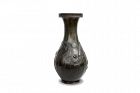
Sold Tall dark bronze vase decorated with a bas-relief depicting irises (hanashobu) ; the rim with an openwork border with maji-motive.
Bottom marks : Kakuha-Sei, the mark of Sano Takachika, Kakuha Kanzaemon IX (角羽勘左衛門 - active early Meiji period). In 1869 he started a bronze-ware business in Yokohama.
Japan – Meiji (1868-1912)
Height: 15.7 in. (40 cm) – Diameter: 7.9 in. (20 cm)
Netherlands Private Collection
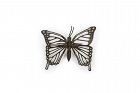
Fine iron jizai of a butterfly with articulated wings.
The butterfly (choho) in Japan is perceived as "the soul of the living and the dead", the spirits of the dead taking the form of a butterfly on their journey to the other world. The butterfly spreading its wings is a symbol of femininity. It can also symbolize joy and longevity. This last motif is taken up by the samurai, seeing in its twirling figure a motive of good omen allowing them to reach immortality...
GALERIE TIAGO
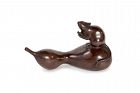
Sold Funny brown-patinated bronze featuring a mouse standing on its hind legs on a squash.
Japan – Meiji (1868-1912)
Height : 14 cm (5.51 in) - Length : 24 cm (9.45 in) – Width : 8 cm (3.15 in)
Zentner Collection
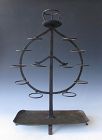
$1,250.00 Antique Japanese iron tomyodai Shinto votive candle holder in the form of a hoju (precious jewel). 12 circular rings for candles and one at the very top of the jewel's point. Attached to a stand with four feet and a rectangular tray to catch the wax from melting candles. From a Buddhist temple or Shinto shrine.
Age: Meiji Period (circa 1900-1910) Dimensions: 25 1/2" high x 17 1/2" wide x 8" deep
Dragon's Pearl
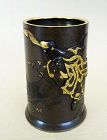
$1,300.00 A fine bronze brush pot decorated with the Rakan Handaka Sonja holding the begging bowl in gilt takazogan, in a combination of high relief and incised landscape with banana leaves and flowers. Gilt top rim. Incised signature on the Kyoto Kumagai zo (made by Kumagai). H. 9,5 x D 6,5 cm.
Meiji period (1868-1912) . Very good condition.
Zentner Collection
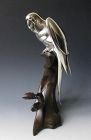
Price on Request Antique Japanese Art Deco bronze and silver figure of a parrot sitting on a holly branch. Elegant simplified lines and form with swooping tail and copper color eyes. In two sections. Signed by the artist, Tanshо̄ Inoue. He was famous for his Art Deco bronze work during the Taisho Period and a member of Tokyo Chukinkai (Tokyo Cast Bronze Craftman's Association)...
Kodo Arts
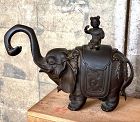
$580.00 Well defined bronze elephant koro incense burner, C.1920. 18cm tall by 15cm wide. Very good condition.
Kodo Arts
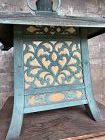
$1,800.00 Large, impact thick bronze hanging lantern, C,1935. gorgeous lattice work on all panels. Great condition with natural age markings. h:53 cm x w: 44cm. Ask for shipping quote.
Kodo Arts
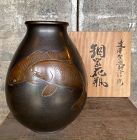
$550.00 Elegant signed Keisen bronze vase with carp undulating and frolicing about. With original paulownia signed box. Characters on box read: "Daruma seiyu koi bori doki kabin" meaning daruma holy playing carp bronze flower vase. C. 1950.
excellent condition. Ask for shipping quote.
GALERIE TIAGO
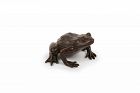
Sold Okimono in bronze of a frog.
Seal of the founder or of his factory on its belly, not identified.
The frog (kaeru) is associated with luck and wealth. Kaeru means both "frog" and "coming home" in Japanese. This extension of meaning is due to the ability of the frog to return each year to the pond of its birth. A gong in the shape of a frog can thus sometimes be used as a door hammer or to protect a house.
Japan - Meiji Era (1868-1912)
Height: 1.4 in...
Hitotsusage tabacco pouch with a netsuke. Unlike the tabako-ire, there is no kiseru case.
Netsuke of kagamibuta type, made of two parts: a silver plate with peonies decoration and an ivory bowl.
Leather snuffbox (pouch) with menuki (metallic decoration) of a silver dragon. On the pouch, painted decoration of a Hôô phoenix surrounded by flowers...
GALERIE TIAGO
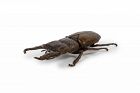
Sold Bronze sculpture of a giraffe beetle (Prosopocoilus girafa). The top of the abdomen is raised, revealing a perfume burner. The lucanus, in Japanese kuwagata mushi, is highly valued for its playfulness and aesthetic value.
Insects (mushi) have a very important place in Japanese culture. Insect hunting is a popular pastime, especially among children. Using nets and cages, they catch cicadas, beetles and other insects to observe them...
GALERIE TIAGO
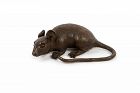
Sold Bronze okimono with brown patina of a mouse lying down. The coat, the tail and the legs are chiselled. The details of the head are particularly detailed, such as the moustache hairs and the long eyelashes.
In Japan, the term nezumi refers to both the mouse and the rat. They are regarded as the messenger of Daikokuten, the deity of trade and wealth...
|