| Home | | | Items For Sale | | | Shops | | | Current Auctions | | | Auction Information | | | Auction Schedule | | | My Vervendi | | | Seller Registration | | | Bidder Registration (free) |
| Directory: (25584) |
|
Auctions MAIN CATEGORIES
|
Abacus Asian Art
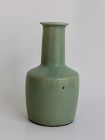
Sold, Thank you very much Spectacular found of Southern Song Dynasty Longquan Ware Mallet vase with well balance potted, and short flared out mouth rim and covered overall with nice olive green glazed. Condition is very good, no any chip, no any crack and free from any restoration. Height: 17,3 cm.
Abacus Asian Art
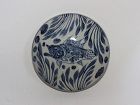
SOLD A rare blue and white covered box, decorated with a fish among waterweed,
condition is good, excepted two-three chips to the inner rim, otherwise is very good, no any crack, no any other chip and free from any restoration.Yuan Dynasty 13th-14th century founded at Indonesia archipelago. Diameter: 13 cm and Height: 5 cm.
Asian Art Online
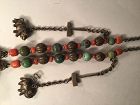
$475.00 A beautiful 19th C. Chinese silver lock pendant with turquoise and coral beads chain, with beautiful patina and marked in excellent condition! Pendant W:3” $475
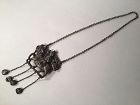
A beautiful Chinese Kirin pendant with boy riding for child and silver chain in excellent condition. Pendant W:3”. $275
Kyoto Ceramics and Fine Art
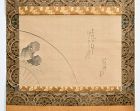
Sold, Thank You! This Edo period scroll depicts Meota Iwa—a famous Japanese landmark in Mie. Symbolizing the union between two divine deities, Izanagi (said to be the larger rock, though there is no consensus on this point) and his wife Izanami, the two are joined by a shimenawa (heavy straw rope used in Japanese Shinto ceremonies). This straw rope is quite massive and must be replaced several times a year in a special ceremony. One could think of this in terms of the care and maintenance required to keep a ma...
Abacus Asian Art
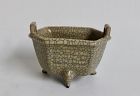
Price on Request Extremely rare tripod censer in hexagonal form, decorated to the body with molded Eight Trigrams, underglazed is obviously have the term of Geyao, which called as iron black and golden crackles to entire body. Southern Song Dynasty or Yuan Dynasty Ge Ware. Condition is perfect with no any chip, no any crack and free from any restoration. Wide: 12 cm and Height: 7,3 cm.
Modern Japanese Ceramics
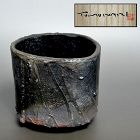
Sold, thank you! An eccentric crusty bowl, very different, by Hashimoto Tomonari enclosed in the original signed wooden box titled Raku Yaki Yohen Chawan. Unlike his normal burnished and color ridden surfaces, this bowl is ominous, matte, shot through with pin-hole-textures and rivulets streaming from the rim. It is like something from deep within the universe, an ancient traveler which has been charred and scarred on its way through the atmosphere. Not only that but it is slightly deeper than his normal bowl...
Japanese : Woodblock Prints : Pre 1940
item #1452786
(stock #Unidentif145)
Era Woodblock Prints
SOLD Peerless Mount Fuji
Unsigned. Artist not identified. Date: 1934. Size: Oban. Approximately 13.75 x 10 inches. Origin: Issued as a folded insert to an N.Y.K. Line publication called, "Glimpses of the East". The folds are vertical. Medium: Japanese woodblock print. Condition: A faint foxing spot at the upper left. The composition of this print is reminiscent of the Fuji views of Tsuchiya Koitsu.
Modern Japanese Ceramics
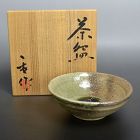
Sold, Thank you! Crackled green glass pools in the center of this humble tea bowl by Ezaki Issei enclosed in the original signed wooden box titled simply Chawan. The works of Issei personify the humble virtues of the tea ceremony. They are imbued with a sense of Musakui (Lack of intention), a bowl that has come to be, rather than a bowl that was created. It is 15.5 cm (6 inches) diameter, 5.5 cm (2-1/4 inches) tall and in excellent condition.
Ezaki Issei (also Esaki, 1918-1992) was born in Tokoname, bu...
Zentner Collection
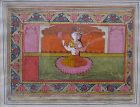
sold Antique Indian miniature painting of Adharanishvara, the combination of the God Shiva and his consort Parvati in one body. The half male, half female represents the union of opposites, the universal principles: masculine, Purusha and feminine, Prakriti. In this painting, Parvati is easily identified by her beauty and crown. Shiva is identified by the snake the encircle both their neck, his tiger cloth, and his long hair which is secured on top of his head. As traditional, the couple...
Zentner Collection
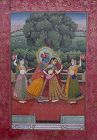
SOLD Antique Indian miniature painting of Radha and Krishna in the garden. Best known for their love to each other, the God Krishna and his true love, the Goddess Radha are two of the most adored deities in Hinduism. While strolling the hills, Krishna often played his flute for the grazing cows. A young and beautiful gopi (caretaker of cows) heard his flute and the two fell in love. In this painting we see the young couple flanked on either side by two attendant girls. In the background is the...
Zentner Collection
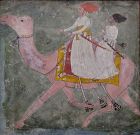
$2,500.00 Antique Indian painting of two men riding on the back of a camel. Beautiful detail work in their garments and hair. The quick gait of the camel is conveyed in it's wide steps and the backward motion of the tassels and drapery. Painted in gouache pigments on paper. Framed.
Age: 18th/ 19th century Dimensions: Art: 9 3/8" high x 9 5/8" wide. Frame: 18 3/8" high x 18 3/8" wide.
GALERIE TIAGO
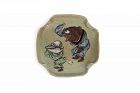
Sold Polychrome celadon ceramic four-lobed tray with two fish yôkai dressed in yukata, a light kimono worn in summer. The yôkai are supernatural creatures from Japanese folklore. Most of the ceramic is glazed, except for the brown skin of yôkai which has a matte finish.
Unidentified mark.
Japan - Taishô era (1912-1926)
Height: 1.2 in. (3.4 cm) - diameter: 6.3 in. (16.3 cm)
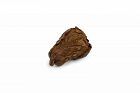
Okimono of a Chinese cabbage made in woodbox. The texture and veins have been delicately detailed.
Native from China, it is an herbaceous plant of the Brassicaceae family. It is eaten in many ways in Asia: in soup, in salads, stir-fried, in ravioli of filled patties.
Japon – Meiji era (1868-1912)
Height: 2.4 in. (6.5 cm) – Diameter : 1.6 in. (4.5 cm)
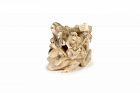
Ivory okimono of a toad carrying an orchestra of five monkeys.
Four monkeys is playing instruments such as the shamisen (long-necked lute with three strings), the shime-daiko (small drum) and the flute. The fifth monkey is larger and is singing while holding a book in his left hand and plugging his ear with the other. They are wearing a jinbei, a summer outfit consisting of a short-sleeved jacket and shorts.
Japan - Meiji Era (1868-1912), late 19th or early 20th century...
GALERIE TIAGO
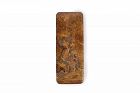
Sold Long suzuribako (calligraphy box) with nashiji lacquer background, plum tree decoration in a lake landscape in takamaki-e, kôrin maki-e and kirigane. The plum tree (ume), which blooms at the beginning of the year, announces spring. Its flower is a symbol of protection against demons. On the inner lid, decoration with seven flying birds near a coast with clouds. Pewter inlay on the nodes of the trees in the style of Ogata Kôrin.
The kôrin maki-e is a technique developed by Ogata K...
GALERIE TIAGO
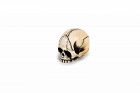
Sold Ivory netsuke of a human skull.
Japon – Meiji era (1868-1912)
Height 1.2 in (3 cm) – length 1.4 in (3.5 cm) – width 1 in (2.5 cm)
GALERIE TIAGO
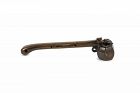
Sold Hishaku-gata style yatate in bronze with brown patina. The hishaku-gata style was developed at the beginning of the Edo era, in the 17th century. It is characterized by an ink compartment (sumi tsubo) in the shape of a ladle. Here it is decorated with a frog.
The frog (kaeru) is associated with luck and wealth. Kaeru means both "frog" and "coming home" in Japanese. This extension of meaning is due to the ability of the frog to return each year to the pond of its birth. A gong in the shape ...
|