| Home | | | Items For Sale | | | Shops | | | Current Auctions | | | Auction Information | | | Auction Schedule | | | My Vervendi | | | Seller Registration | | | Bidder Registration (free) |
| Directory: (25589) |
|
Auctions MAIN CATEGORIES
|
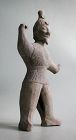
Fine Large Chinese Western Jin Dynasty Armoured Warrior (AD 265 - 316)
This impressive and very rare pottery model of a warrior was made during the Western Jin Dynasty (AD 265 - 316). It is quite "heavily-potted" and made from a fine-grained grey pottery that is relatively highly-fired, having an almost metallic ring to it when tapped. He is wearing an armoured jacket, belted at the waist and an elaborate helmet whilst standing legs apart to steady himself, in the act of throwing a spe...
Forestangel Asian Antiques
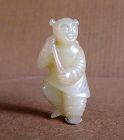
$1,250.00 This is a finely carved Celadon Jade figure of a Boy holding a Lotus Leaf Branch. It is a mostly of natural celadon color with a small patch of russet color in the back, near the waistline. This excellent rendition of a traditionally groomed 18th Century Boy is in excellent preserved condition.
Provenance: Bonham's
The Celadon Jade Boy here is similar to one being auctioned by Zacke Galleries, Vienna, Austria, on 11 March 2022, with an estimated cost of 2,000 to 4,000 Euros. (see photo...
Forestangel Asian Antiques
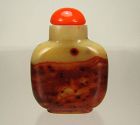
$645.00 This is a 19th century, flattened, Square form with rounded shoulders, Jasper Snuff Bottle. It has a design prevalent mostly in snuff bottles made during the 18th century and early 19th century. It has banded Red, orange, brown, and beige colors, and chocolate spots. It has a raised rectangular base.
The bottle comes with a glass red stopper. It is in excellent preserved condition.
Bottle Measurements
Height: 1.93 inches (4.9cm) - Not including stopper
Width: 1.74 inches (4.4...
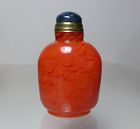
This is a 19th century made bottle of a thick Bulbous rectangular form with rounded edges, thick straight neck, wide lips and mouth, and recessed oval footing.
The well-hollowed bottle has been made in imitation of Realgar, with its mottled shades of red and orange in erratic nebulous forms. Its form was commonly used in the 19th century, and its illustrated in the 'Collector's Bood of Snuff Bottles', item #165, page 65. It comes with a blue aventurine stopper with metal collar. It is in...
Chinese : Snuff Bottles : Pre 1900
item #1462661
(stock #335)
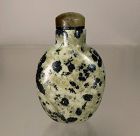
This is a 19th Century, flattened rectangular with rounded shoulders form snuff bottle, rounded short neck, and flat oval footing. It is made from Puddingstone. The stone has a creamy creamy suffused background, with blots of gray and black. It comes with a grayish russet stopper with spoon. This elegantly looking piece is in excellent preserved condition.
a similar form sand material snuff bottles is illustrated in 'The Collector's Book of Snuff Bottles", by Bob C. Stevens, Item 666 page ...
Chinese : Snuff Bottles : Pre 1900
item #1462660
(stock #334)
Forestangel Asian Antiques
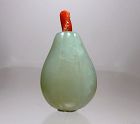
$1,450.00 This is a finely carved Celadon Jade Snuff Bottle, in the form of a Lobed Gourd. It is a mostly of natural celadon color ground with a small curved russet line near its mouth, and a spot of gray on one of its sides. It comes with small thin coral stopper with spoon. This great looking bottle is in excellent preserved condition.
Bottle Measurements
Height: 1.98 inches (5.0cm) - not including stopper
Width: 1.42 inches (3.6cm)
Thickness: 0.98 inches (2.58cm)
Weight: 1.4 ounce...
Forestangel Asian Antiques
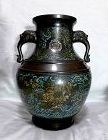
$975.00 This is a large and spectacular 18th Century Bronze Cloisonne, Twin-Handle Urn with great Archaic form and color. It has two Dragon Head Handles. It is enameled with Penny Flowers and Leaves motif. It has a large mouth (five-inches wide), and it is decorated with a one-inch belt that separates its bulbous body from its neck. It has a raised foot rim.
It is stamped with the Japanese kanji that spells the name of its maker: 嶋佐 Shimasa, and it is in excellent preserved condition.
M...
Japanese : Woodblock Prints : Pre 1940
item #1462651
(stock #YoshidaH061)
Era Woodblock Prints
$1,475 Hiroshi Yoshida
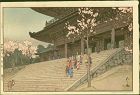
Chion-in Temple Gate Series: Eight Scenes of Cherry Blossoms. Date: 1935. Print size: Oban. 16 x 10.75 inches. Brush signed and sealed in the image. Titled and signed in pencil in lower margin. Jizuri seal at upper left margin indicating a first edition self-printed by the artist. Medium: Japanese woodblock print. Publisher: Hiroshi Yoshida Reference: Abe catalog #194. Condition: Two short scratches in stairs (see photo). Tape at ... Tall Chinese Ming Dynasty Stoneware Roof Tile Figure
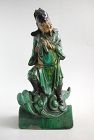
This impressive architectural ridge tile figure was made during the latter part of the Ming Dynasty (1368 - 1644), most likely in Shanxi province. It depicts an official figure or guardian / deity figure standing on top of swirling clouds. It is coated in thick green, turquoise, black and straw-coloured glazes. Height 38 cm (15 inches). There are minor losses to the extremities, as should reasonably be expected for such an item, but ...
t a t a m i
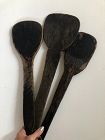
$250.00 しゃもじ / THREE LARGE RICE PADDLES Wood, early-mid 20th century, Korea, approx. L 42-45.5 x W 10-13cm (16.53-17.91 x 3.93-5.11in), in such aesthetically well-used condition as is. selected by kikue * Please understand that EMS shipping fee is additionally charged, and also confirm our Sales Policy before purchase, since your order will be assumed to have fully acknowledged our Sales Policy under any c...
Haruko Watanabe
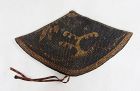
$250.00 Nirayama-kasa which was worn by samurai when they practiced artillery. It is made of washi (Japanese handmade paper) yarn and black urushi painted outside and kakishibu inside. It has hand-painted wave and bamboo design with gold but faded much. Nirayama-kasa was made in Ansei (1854~1860), very late Edo period. It was used in Kanto area, not in Kansai area, according to the "Kinsei Fuzokushi" written by Morisada Manko around mid 19th century. Generally in good condition but has some wear. W:50.5...
Japanese : Woodblock Prints : Pre 1960
item #1462619
(stock #Saito025)
Era Woodblock Prints
SOLD Kiyoshi Saito
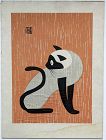
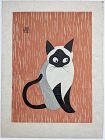
Siamese Cat (2) (Early Cat) Date: ca. 1940s-50s. Paper size: Approximately 23.675 x 18 inches. Image size: Approximately 19 x 14 inches. Sealed but not signed. Self-published by the artist. Medium: Japanese woodblock print. Condition: Laid down to board. Wrinkling. Stain at lower margin. Note: In the last image, I show this print paired with another cat (our Saito 026). These cats also appear together in another Saito design known as "Ca...
Japanese : Woodblock Prints : Pre 1960
item #1462617
(stock #Saito026)
Era Woodblock Prints
SOLD Kiyoshi Saito
Siamese Cat Date: ca. 1940s-50s. Paper size: Approximately 23.675 x 18 inches. Image size: Approximately 19 x 14 inches. Sealed but not signed. Self-published by the artist. Medium: Japanese woodblock print. Condition: Laid down to board. Light wrinkling. Note: In the last image, I show this print paired with another cat (our Saito 025). These cats also appear together in another Saito design known as "Cats".
Haruko Watanabe
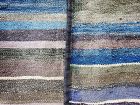
Sold. Thank you. Sakiori sodenashi (vest) handwoven of cotton strips recycled from old kimono for weft and asa (hemp) yarn for warp. It has beautiful mixed color of indigo, brown, purple etc. In good condition. The first half of the 20th century. W:48cm, L:73cm
Haruko Watanabe
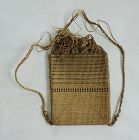
$250.00 Rare bag for back pack made of plant, possibly "suge" (Carex) but not 100% sure. It is hand-knitted with very skillful technique. Used by a mountain worker. In excellent condition. 20th century. L:38cm W:27cm
Zentner Collection
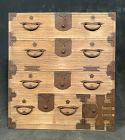
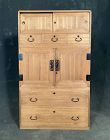
$2,000.00 An antique Japanese Nihon Matsu Kasane Tansu (stacking Kimono chest) made of Kiri (Paulownia) wood. All original hand forged iron hardware including the Warabite handles and the double Plum Blossom handle stoppers called Atari. Upper section features 2 full width drawers and the bottom section has 1 full drawer, 1 partial width drawer, a hinged security door and two small drawers where valuables were kept. Constructed using straight dovetail joinery and hardened wooden nails. Typically very l...
Zentner Collection
SOLD An antique Japanese 3 section Isho Biraki Tansu made of Kiri (Paulownia) and Sugi (Cryptomeria) woods. All original bronze hardware. Upper section features a pair of sliding doors behind which lies a spacious storage area with a split level shelf with three side by side drawers below. The center section has two hinged doors that hide three removable Kimono trays while the bottom section has two drawers for added storage. Constructed using straight dovetail joinery and hardened wooden nails. ...
Zentner Collection
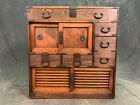
SOLD An antique Japanese Choba Tansu (merchant chest) made of Tochinoki (Horse Chestnut) and Hinoki (Cypress) woods. All original lhand forged iron hardware including the Warabite handles. Six drawers of varying sizes with 2 sets of sliding doors. Merchant records and books were stored behind the upper doors. The lower doors hide three small drawers, a storage area for more records and a secret hiding drawer where valuables were kept hidden from possible thieves. Carrying handles to each side of...
|