| Home | | | Items For Sale | | | Shops | | | Current Auctions | | | Auction Information | | | Auction Schedule | | | My Vervendi | | | Seller Registration | | | Bidder Registration (free) |
| Directory: (25583) |
|
Auctions MAIN CATEGORIES
|
Modern Japanese Ceramics
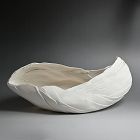
sold, thank you A long low basin by Lu Xueyen in translucent white porcelain enclosed in the original signed wooden box titled Enfolding II. It is 21.5 x 38 x 15 cm (8-1/2 x 15 x 6 inches) and is in excellent condition, directly from the artist.
I have been following the diaphanous works of Lu Xueyun (known in Japan by the Japanese reading of her name, Ro-san) for nearly 5 years and waiting for the opportunity to introduce her to the outer world. Lu Xueyun was born in Chongqing, China in 1987 an...
AntiqueTica.com
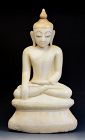
$3,400.00 Burmese alabaster Buddha sitting in Mara Vijaya (calling the earth to witness) posture on a base.
Age: Burma, Shan Period, 18th Century
Abhaya Asian Antiques
$160.00
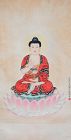
Beautiful traditional Chinese brush painting of the Buddha mounted on a beige silk scroll, excellent condition. He is sitting on a lotus throne with his right hand raised in the Shuni mudra symbolizing patience and discipline. There is an apocryphal dating of 1845 Buddha’s Birthday, Daoguang reign and signature of Reqin. Mounted size is L: 203cm/80in and W: 78cm/31in- actual painting size is L:131cm/51in and W: 66cm/26in. Circa last quarter of 20th century.
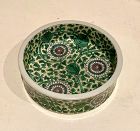
A Chinese famille verte yellow-ground brush washer, of shallow circular form, robustly potted, the sides very slightly waisted. 13 cms diam. Kangxi mark. Qing dynasty, 19th century.
Perfect condition.
DAY FINE ARTS
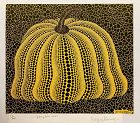
CONTACT FOR PRICE signed in pencil, titled and numbered 17/200
screenprint in colors on wove paper
image: 11¾ by 13¾ in. 209 by 350 mm.
Executed in 2000; this impression is number 17 from the edition of 200 plus 20 artist's proofs, published by Serpentine Gallery.
NOTE: The print has been cut from the sheet, the edition number, title and signature in pencil are below.
The image is in excellent condition. A print from the exact same edition sold at Bonhams auction London
for £48,000 in 2022 This is an op...
Momoyama Gallery
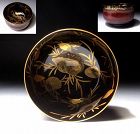
$450.00 Rarely seen Japanese Haisen Bowl with wonderful gold Makie (Maki-e), made around 1900 during the Meiji Period (1868 - 1912). The wooden-based bowl is coated with high quality Japanese lacquer. Seashells are molded and hand-painted inside of the bowl by gold Maki-e technique. This type of bowl is called "HAISEN" in Japanese. Maki-e (蒔絵, literally: sprinkled picture) is Japanese lacquer sprinkled with gold or silver powder as a decoration using a makizutsu or a kebo br...
tomoe art
$1,400.00 A large antique painting depicted inkwash landscape. A man is fishing in a small boat in the silence. The quiet and peaceful scene are depicted beautifully in rich ink tones. Painted with ink on silk. Signed Tsunenobu and sealed. Edo period. It is attributed to Kano Tsunenobu.
Kano Tsunenobu (1636-1713) was the eldest son of Kanō Naonobu (1607-50), younger brother of the renowned artist Kanō Tan'yū (1602-74). When his father died, Tsunenobu became a pupil of his uncle, and derived elem...
tomoe art
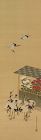
$1,250.00 Antique painting depicted a flock of crane and chrysanthemum. Painted with ink and pigments on silk. Signed Tosa no mori Fujiwara Mitsusada and sealed. Edo period. It is attributed to Tosa Mitsusada.
Chrysanthemums have long been prized in China as an elixir of eternal life and longevity, and have been cultivated as medicinal plants since ancient times. It is said that it was brought to Japan from China during the Nara period (8th C.). It seems that various varieties of chrysanthemums wer...
AntiqueTica.com
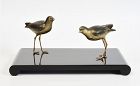
$1,350.00 A pair of Japanese bronze standing birds on the stand with artist sign.
Age: Japan, Showa Period, Early 20th Century
Japanese : Tea Articles : Pre 1700
item #1488745
(stock #TRC240112)
Kyoto Ceramics and Fine Art
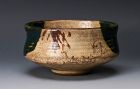
$2,150.00 Oribe is a visual style named after the late-16th-century tea master Furuta Oribe (1544-1615). Typically, black or green glazes are applied to the bodies of these works and light-colored windows are created using feldspar. These high-contrast areas then act as a canvas upon which abstract, minimalistic, and often naturalistic themes are painted. As can be seen here, this piece is of the green variety and looks to be from the mid-to-early Edo period as can be determined ...
Japanese : Tea Articles : Pre 2000
item #1488739
(stock #TRC240120)
Kyoto Ceramics and Fine Art
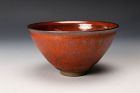
Sold, Thank You! A mesmerizing piece of ceramic art, this exquisite tenmoku tea bowl embodies the rich traditions of Japanese craftsmanship that are inspired by over a millennia of Chinese artistry. With its distinctive deep red glaze, reminiscent of brilliant sunsets, red chili peppers, and festival colors; its presence creates an enchanting visual allure. The bowl's form is elegantly simple, with a gently flared rim that invites contemplation. Crafted with precision and care, this piece reflects th...
Modern Japanese Ceramics
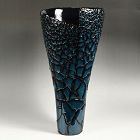
sold, thank you A spectacular large vase by Kashima Aya featured at the “Ceramic Synergy Exhibition” held at the Kyoto Kyocera Museum of Art in late 2023. In fact, the initial form is created, then a thin layer of ceramic is made separately, dried, then cracked, and the individual pieces are applied like mosaic to the prepared form. The space in between the tiles is then abraded, the tiles glazed with color and the space n between glazed with iron. Each piece requires a great amount of painstaking dedicati...
t a t a m i
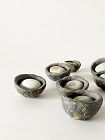
$350.00 STONES IN THE BEDS Stones are from Tsugaru coast in Western Aomori area, Northern Japan, with smooth feeling of touch as its features. Beds are made of pottery. approx. 6 x 6 x H 3 cm (2.36 x 2.36 x 1.18in) each. selected and made by Jinta * Please understand that EMS shipping fee is additionally charged, and also confirm our Sales Policy before purchase, since your order will be assumed to have fully acknow...
Haruko Watanabe
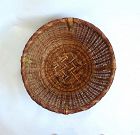
$120.00 A large basket handmade of bamboo strips. In excellent condition except for a minor break, however no problem for use. 20th century. Diameter:43.5cm, H:17cm
The Kura
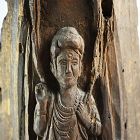
sold, thank you A protective deity is carved into this Piece of a pillar from Himeji Castle dating from the Meiji period restoration of the Tenshukaku (main tower). It is branded with the Yaki-in which reads Himeji Jo Ko-zai-in (Brand of the old wood from Himeji Castle). It has long been a method of raising funds in Japan to offer replaced pieces of a historical building to those who donate to the restoration. These pieces are commonly branded with a special seal, called a yaki-in, which is heated and burnt ...
Modern Japanese Ceramics
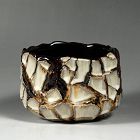
sold, thank you A large white Tea Bowl by Kashima Aya enclosed in the original signed wooden box. The technique is deceptively complex. In fact, the initial form is created, then a thin layer of ceramic is made separately, dried, then cracked, and the individual pieces are applied like mosaic to the prepared form. The space in between the tiles is then abraded, the tiles glazed with color and the space n between glazed with iron. Each piece requires a great amount of painstaking dedication to complete. It is ...
Hundred and One Antiques
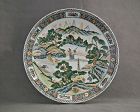
$4,000.00 Antique Chinese 17th century Qing Dynasty Kangxi period. Large, Famille Verte porcelain charger signed with artemisia mark. Fine hand-painted and enameled with landscape scene of a mountainous river with trees, houses, a viewing pagoda, and various figures on a bridge and shore, including a fisherman seated in a boat. All surrounded by a band of twelve rectangular panels containing flower heads. The rim is adorned with a band of latticework.
The base with the unglazed channel foot rim enclo...
Southeast Asian : Edged Weapons : Pre 1940
item #1488691
(stock #ES1178)
Hundred and One Antiques
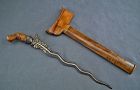
$600.00 Antique late 19th—early 20th century Indonesian Malaysian Malay short sword—dagger, Kris—Keris, with a robust, extremely well-made serpentine-shaped wilah (blade) with 9 luk (waves). The blade is exquisitely crafted from hand-forged iron in various layers with a very unusual pattern. It is also decorated on both sides with a finely hand-carved and inlaid yellow metal crowned Naga (mythological serpent).
A handle, also called hulu or ukiran, is carved in the shape of Jawa Demam, a deit... |