| Home | | | Items For Sale | | | Shops | | | Current Auctions | | | Auction Information | | | Auction Schedule | | | My Vervendi | | | Seller Registration | | | Bidder Registration (free) |
| Directory: Japanese: Textiles: Kimono (344) |
|
Auctions Shops Active In This Category
MAIN CATEGORIES
|
japanes antique textile saiyuu2
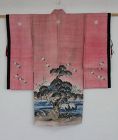
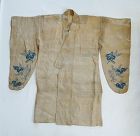
$1600.00 This is a Japanese antique child kimono hand Yuzen-dyed on handspun & natural hemp safflower-dyed fabric, from the Edo period. There is a slight slight stain, but it is not noticeable. There is no damage and it is in very good condition.Size::Length:99cm(38.9inch) /
Cuff to cuff, across the back:93cm(36.6inch)
japanes antique textile saiyuu2
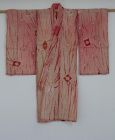
sold thank you It is a Japanese antique child kimono of hemp ground handspun & natural safflower dyed and shibori dye "Fan face & Hinomaru" pattern of Meiji period.There is a slight slight stain, but it is not noticeable. There is no damage and it is in very good condition.size::Length:89cm (35inchi) Cuff to cuff, across the back:83cm (32.6inch)
japanes antique textile saiyuu2
$1500.00 This is a Edo Period Child kimono of Hemp Indigo dyeing Kasuri Echigo-jyofu. Chinese phoenix, butterfly, cherry tree.It is a very beautiful indigo dyed linen. It is in very good condition with no stains or damage.
Size:length99cm ( 35.8inch) / Width:99cm (38.9inch)
Haruko Watanabe
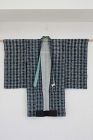
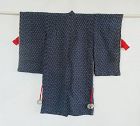
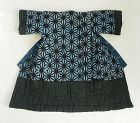
Sold. Thank you. Hanten remade from Echigo-jofu kimono which is handwoven with choma (ramie) and both weft and warp are hand-plied. Echigo-jofu has been woven in Echigo region in Niigata prefecture since ancient time. Especially, pictorial and cross double kasuri patterns were very popular and much produced in late Edo period (the first half of the 19th century). Those Echigo-jofu with cross double kasuri kimono are seen many in Ukiyo-e. This hanten has double kasuri pattern and stripes. 19th century...
Haruko Watanabe
Sold. Thank you. Baby's ceremonial kimono made of Echigo-jofu which is hand-woven of choma (ramie) and dyed with indigo. The fine kasuri pattern is yoko-gasuri (weft kasuri) and bamboo, pine tree and plum bloom motifs. Echigo jofu was first woven asa kasuri in mainland Japan having been influenced by Ryukyu (Okinawan) kasuri. The dye is called Ai-sabi which is very dark blue dyed with vegetable indigo mixed with shoen (burnt pine shoot) or other catalysts...
Haruko Watanabe
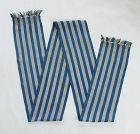
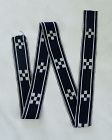
Sold, Thank you. Shonai obi (sash) hand-woven of cotton for warps and paper yarn for wefts. It is made in Shonai region in Yamagata prefecture in Tohoku district. It is dyed with vegetable indigo and has beautiful tassels in both ends. In excellent condition except for a few tiny stains. The first half of the 20th century. 29cm x 3m56cm
Haruko Watanabe
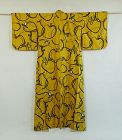
Sold. Thank you. Silk meisen kimono with double kasuri apple and strawberry pattern on yellow ground. Kasuri pattern was dyed with stencil-resist-dye (katazome) for both weft and warp yarn (heiyo-kasuri). Generally in good condition but has some brownish stains and some in the lining too and the silk tape in the hem is a bit dirty. Mid 20th century. 126cm x 146cm
Haruko Watanabe
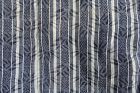
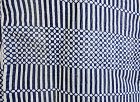
$80.00 Cotton kimono with geometric pattern. The weaving technique is "Kobai-ori" which is woven with thick and thin yarn loosely so that it is translucent. In excellent condition. Mid 20th century. 142cm x 124cm
Conservatoire Sakura
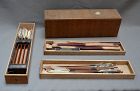
$4,500.00 Dismountable miniature bow of Geïshas. Some prints show us Geïshas using such a bow. Excellent quality, nice shakudo, silver and gilded bronze mounts well chiseled. The wooden parts are finely carved like a violin bow. It is stored in a box with 3 drawers where 16 arrows are set, most of them with golden characters. The arrows are made of wood and bone spiral or tinted green, and are weighted by a steel tip, some parts are lacquered and gilded...
japanes antique textile saiyuu2
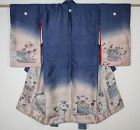
sold thank you This is a Japanese antique indigo dye silk Hand-painted dyeing child kimono.It is a very elegant and very beautiful children's kimono with hand-painted Yuzen dyeing and embroidery. It is a charming and elegant design of kaioke and chrysanthemums and peony...
Haruko Watanabe
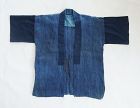
Sold. Thank you. Noragi (work wear) made of asa (hemp) whose both wets and warps are hand-plied. The sleeves are vegetable indigo dyed cotton. A few holes with mending patches. Late 19th to mid 20th century. 109cm x 71cm
japanes antique textile saiyuu2
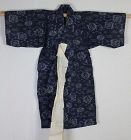
sold thank you The end of the Edo period omijyofu indido dye hemp kasuri child kimono of charming pattern of treasure.There is no stain. There are two small holes in the sleeve. , but they don't stand out.
It is a very delicate jyoufu hemp and is the best children's kimono. A hand-embroidered amulet is attached to the back. The silk waist straps on a white background are all original.
It was carefully communicated and stored. I recommend it to your collection...
Haruko Watanabe
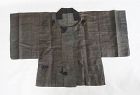
$600.00 Rare item. Rokushaku Kanban which was worn by a palanquin bearer (kago-kaki) who was a servant worked for a feudal lord (tono-sama) and a bearer of a palanquin when the lord went out. There are various theories that the kimono is called "Rokushaku-Kanban": servants worked in the lord's residence or a castle are called "rokushaku" and the kimono has "kanban" which means a symbol or a family crest...
Haruko Watanabe
$120.00 Minsa obi (sashi) made in Taketomi Island in Okinawa.
The features of Taketomi Minsa obi are: both wefts and warps are machine-spun cotton and handwoven. It has four and five block warp kasuri pattern and both selvedges have uneven horizontal stripes which symbolize mukade (centipede). Minsa obi was a gift from a woman to a man meaning acceptance of engagement in old days. In excellent condition. 20th century. 8cm x 2m4cm
u
Haruko Watanabe
$300.00 Baby's yogi which is one kind of bed cloth, a top cover in the shape of kimono. It has cotton cloth with katazome (stencil-resist-dye) for outside and indigo cotton for the lining. It has thick cotton inside for warmth and was used in the cold district or in winter. It is from Fukushima prefecture in Tohoku district. In good condition but has some light stains in the wrists and mending patches in the top shoulder. The first half of the 20th century. 92cm x 88cm
Haruko Watanabe
Sold. Thank you. Han-gappa (short jacket) made of kuzdu-fu whose wefts are kudzu fiber and warps are cotton. Kudzu is one kind of leguminous plant. The collar is made of imported wool. Han-gappa made of kudzu-fu was worn in summer and other ones with lining was for winter. The design of the straps show it was made after Tenpo era (1830∼1844)in Edo period, according to the "Kinsei Fuzoku-shi" Buttons are made of the horn of the water buffalo...
Haruko Watanabe
$90.00 Cotton lining for narrow sash (obi). Most of the fragments
are hand-spun cotton cloth, such as plain cotton indigo dyed, itajime mame-shibori (clamp-board dye), katazome (stencil-resist-dye) etc. The second half of the 19th century. 15cm x 4m50cm
japanes antique textile saiyuu2
$188.00 Japanese antique cotton child kimono of hand shibori (Tie-dye)From Edo to Meiji era.
This shibori has some protrusions and seems to be rarely used.shibori cotton is a very good hand-spun cotton.
The cotton lining is also charming. There is a slight stain on the sleeve. There is no damage and it is in very good condition.
Size::Length:81cm ( 31.8inch) /
Cuff to cuff, across the back: 93cm ( 36.6inch)
|