| Home | | | Items For Sale | | | Shops | | | Current Auctions | | | Auction Information | | | Auction Schedule | | | My Vervendi | | | Seller Registration | | | Bidder Registration (free) |
| Directory: Japanese: Tea Articles (1139) |
|
Auctions Shops Active In This Category
MAIN CATEGORIES
|
Japanese : Tea Articles : Pre 1900
item #1314875
(stock #0266)
Momoyama Gallery
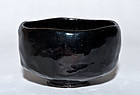
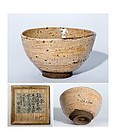
Sold Sold! Impressing black Raku tea bowl of the Raku family, made and signed by the 10th Kichizaemon Tan-Nyu. The signed box is labeled “10th generation”, which means Tan-nyu (1795-1854). The reverse side of the lid has an appraisal of the grand tea master of Omoto-Senke. A stunning tea bowl made from one of the most famous potter clans in Japan. Most pieces of Kichizaemon Tan-nyu are hold in museums...
Momoyama Gallery
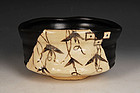
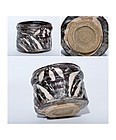
Sold Sold! Little distorted half cylinder shaped (kutsugata) tea bowl made of light, coarse, unrefined Mino clay during the Edo Period with strong black ink glaze and a rarely seen patina. The expertly thrown body is covered with the typical black iron oxide glaze inside and outside. The chawan has a very rare 'decoration' with hanging persimmons (hoshikaki) scratched into the engobe and a tea room window inside and a plum blossom painted under the clear glaze...
Momoyama Gallery
Sold Here we present our second Hagi Chawan from the famous Koraizaemon family. We already offered and sold a Hagi Chawan made by the first Saka Koraizaemon some month ago, please see item number 0211 on our website. This chawan was made by the 6th. Koraizaemon Shinbei Saka (1739 - 1803), accompanied by a wood box with the certificate and appraisal of the 11th Saka Koraizaemon...
Momoyama Gallery
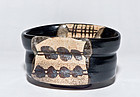
sold Elegant, little distorted half cylinder shaped kutsugata tea bowl with flaring lip made of light, coarse, unrefined Mino clay. The expertly thrown body is covered with the typical, glossy black iron oxide glaze inside and outside, leaving an unglazed 'window' on one side. One 'window' is decorated with circles squares and lines in iron oxide glaze which has been covered with a clear ash and feldspar glaze...
Kyoto Ceramics and Fine Art
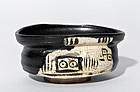
Sold, Thank You! Most noted for his works of Shino, this attractive Oribe piece by Kato Takeshi is distinctive and eye-catching.
Born the son of a potter in 1947, Takeshi studied under Kobayashi Bunichi, Ohashi Momonosuke and later in Kyoto under Uchida Kunio, opening his own kiln in 1973 (Genkuro-gama)...
Kyoto Ceramics and Fine Art
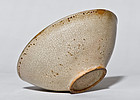
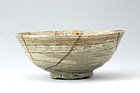
Sold, Thank You! A wide hira-jawan decorated with inlaid white slip in the pattern of flowers and rope. The Mishima style of pottery is modeled after much earlier Korean forms—most notably Punch'ŏng. The gold repairs are extensive and skillfully applied, nicely complimenting the pale ash glaze and adding an extra dimension to this lovely work.
This piece is 5.6 inches in diameter (14.3 cm) and stands 2.3 inches tall (5.9 cm)...
Kyoto Ceramics and Fine Art
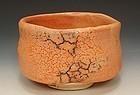
Sold, Thank You! Labeled as yu-Shino on the box or “evening†Shino, this recent composition by Ryouji Hayashi III displays wonderful textures and hues resembling the blazing sky at sunset. The front of the bowl is decorated with radiating fissures— boldly contrasting with the background while the kodai or foot of the bowl is unglazed showing the light-colored clay beneath.
Ryouji Hayashi (1940 - ) is the third generation potter of the Shozan kiln in Mino...
Momoyama Gallery
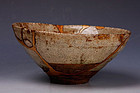
sold Rugged, heavy, startlingly strong and breathtakingly beautiful, Iga ware has a special place in the heart of every collector of tea ceremony items. For many, it is the epitome of Japanese ceramics. From the combination of the potters' hands and the clay itself — at its best, Iga appears to be born rather than made. With Iga ware, nothing is hidden...
Momoyama Gallery
sold Love at first sight! From deep inside the cultural heart of the Japanese Edo Period we are proud to present you another stunning Chawan from our collection...
Kyoto Ceramics and Fine Art
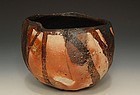
Sold, Thank You! A relatively new term, “Oni Tamba” is used to describe works of Tamba-ware fired using carbon trap and ash glazing techniques modeled after those pioneered by Tsukigata Nahiko in the 1950’s. This piece in particular displays a bold and innovative ceramic landscape that seems quite impressive for such a young artist as Onishi. One side of the bowl resembles charred igneous rock while the front shows a warm soft orangish glow—like an ember in a fireplace...
Kyoto Ceramics and Fine Art
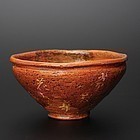
Sold, Thank You! This chawan was made by the 8th generation Ohi Chozaemon (1851-1927) based in Kanazawa and is done in a style known as “ameyu” or candy glazing. The glazing is a wonderful example of ameyu and, in fact, approximates the color of a caramel candied-apple. The interesting color scheme and glossy sheen make it an attractive backdrop for a frothy bowl of dark green matcha. While some tea bowls may look best in the confines of a dimly lit tea room, this bowl looks much better in bright light...
Kyoto Ceramics and Fine Art
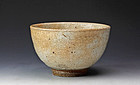
Sold, Thank You! This elegant and mature work of Karatsu pottery has an unglazed foot and beautiful crackled glazing that displays hues ranging from ivory to almond.
Toya Inoue (1942 - ) is a native of the world-renowned pottery center of Karatsu in Saga prefecture. From a young age he was interested in tea and tea-ware and studied tea ceremony under Tansai. Later in his 20’s he was involved in a project to restore ancient kilns...
Momoyama Gallery
Sold Special autumn offer: Another beautiful chawan from our familiy collection: square cylinder shaped (hanzutsu) tea bowl made of light, fine, unrefined Mino clay, with a flaring mouth in shape of a half pipe. Shape and style make it appear contemporary with the late Oribe bowls. The expertly thrown body is covered with the typical black oniita engobe inside and outside - with the exception of the bottom - over which a white, feldspatic Shino glaze has been poured. Just the...
Kyoto Ceramics and Fine Art
Sold, Thank You! This lovely Ido-gata shaped chawan has very nice asymmetrical balance highlighted by extensive and skillfully applied kintsugi gold repairs. The inside bottom of the bowl is covered in a green glaze resembling a carpet of fine moss which stands out nicely agains the backdrop of the ashen-colored crackled glazing of the walls of the bowl.
Stemming from the philosophy of wabi-sabi or, beauty in the imperfect, cracks and repairs in a work of pottery are often seen as highlighting the h...
Zentner Collection
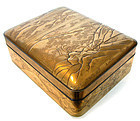
SOLD The Hiramaki-e technique, which dates from the latter part of the Heian Period (794-1185), was preceded by Togidashi maki-e, a technique in which not only the design, but the whole surface is covered with clear lacquer after the sprinkling of metal powder. The lacquer is then polished down to reveal the design.
The Japanese letter box is decorated in low relief of mountainous terrain and a stylized linear mist or cloud line. The interior ground is lacquered and sprinkled with gold fl...
Japanese : Tea Articles : Contemporary
item #1309253
(stock #TRC1506)
Kyoto Ceramics and Fine Art
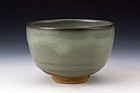
Sold, Thank You! A work of perfection by one of Japan’s most admired ceramic artists. This piece by Nakajima Hiroshi demonstrates his mastery of the art of celadon pottery.
Born in 1941 in Hiroshima prefecture, at the age of 28 he established his own kiln and became an independent potter. 1n 1977 he received honorable mention in the Japan Tradional Applied Fine Arts Exhibition. In 1983 he received the Prime Minister’s Award at the first annual Western Japan Ceramic Fair and later in 1983 he was ...
Kyoto Ceramics and Fine Art
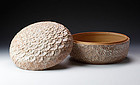
Sold, Thank You! The creator of this extraordinary work, Shibuya Deishi, is best known for his works of “Oni-hagi”—typically made with rough clay and heavy dripping glazes. This piece by contrast seems delicately crafted and has a very soft and warm quality to it. The outside is covered with overlapping molded flower petals done in an almond glaze with ivory accents at the tips of each petal.
Winner of many local and international awards (including the 18th Modern Applied Fine Arts Exhibition...
Momoyama Gallery
Sold Wonderful hand shaped Tanba chawan, made 80 - 100 years ago. The tea bowl is well balanced and has a perfect shape. No chips or cracks. The bottom is signed. Good Wabi Sabi aura. Great! Size: 6,5 cm height x 11,7 cm in diameter. Tanba-yaki pottery originated approximately 800 years ago and has played an essential role in people’s daily lives, as well as becoming sought after as artwork in recent years. Its distinguishing feature is its simplici... |