| Home | | | Items For Sale | | | Shops | | | Current Auctions | | | Auction Information | | | Auction Schedule | | | My Vervendi | | | Seller Registration | | | Bidder Registration (free) |
| Directory: Japanese: Tea Articles (1139) |
|
Auctions Shops Active In This Category
MAIN CATEGORIES
|
Japanese : Tea Articles : Pre 1990
item #1425419
(stock #TRC230221)
Kyoto Ceramics and Fine Art
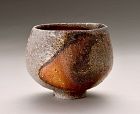
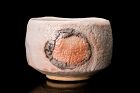
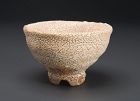
Sold, Thank You! This remarkable tea bowl is from the kilns of Yoshida Shuen (1940-1987)—an apprentice of Miwa Kyusetsu (1910-2012) who was awarded the status of Living National Treasure in 1983. It features a milky translucent glaze somewhat resembling coral, with a few small portions of the foot of the tea bowl exposed, displaying the reddish coarse clay that this piece is fashioned from.
Hagi-yaki has a tradition stretching back over 400 years and is a high-fired stoneware type of pottery...
Japanese : Tea Articles : Pre 1800
item #1425339
(stock #TRC209211)
Kyoto Ceramics and Fine Art
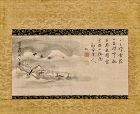
Sold, Thank You! A small cottage perched on the edge of a tranquil lake, fishermen heading out in the morning chill to secure their daily catch. This pastoral scene from the Japanese countryside was captured over 300 years ago by painter, poet, and Buddhist monk Hyakusetsu Genyō (poet) and Kuge Yaou (painter) a monk of the Tenryu-ji sect.
Dharma heir to Chinese monk Gaoquan Xingdun, Hyakusetsu Genyō began his spiritual practice in the Rinzai sect under his teacher Hyakuju...
Japanese : Tea Articles : Pre 1800
item #1425178
(stock #TRC20621)
Kyoto Ceramics and Fine Art
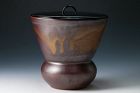
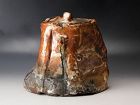
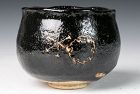
Sold, Thank You! Raku-ware carries with it a very naturalistic aura; with its implements made of raw clay, its use of fire water and air to shape and harden these implements, and with its myriad processes that produce smooth glossy surfaces—like those often found in nature. In fact, if you look more deeply into Raku, you find that many of the shapes and motifs are also inspired by nature...
Zentner Collection
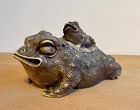
SOLD Unusual Japanese incensor of two Japanese toads made from Izushi Yaki pottery technique. Depicting a large toad with a smaller baby toad resting on top. Smoke rises from the inner chamber an rises and vents from each of their mouths. Beautiful original patina consisting with age. Overall very good condition.
Izushi is a town that continues on from the mythical era. Today it is a castle town popular for its nostalgic atmosphere of old Japan...
Momoyama Gallery
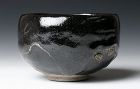
$695.00 One of the most attractive chawan by Ohi Chozaemon VIII (Choraku) (1902-1991) I have seen. It was made around 30 years ago in the style of Raku. The Chozaemon family of potters has been associated with the world of the Japanese tea ceremony since the 17th century. The Chozaemon lineage started with Hodoan (1631-1712), apprentice to the fourth heir of the Raku family of potters...
Momoyama Gallery
sold Sophisticated Bizen Tokkuri (Sake flask) made by one of the best artists of Bizen-yaki, the 2nd. Rakuzan Fujiwara (1910-1996). The Tokkuri was made 50 years ago and is still in mint condition. The surface is covered with natural glaze created with ash...
Japanese : Tea Articles : Pre 1980
item #1423893
(stock #TRC240829)
Kyoto Ceramics and Fine Art
$1,250.00 Over 400 years ago the first Takatori potter known as “Hachizan” was brought to Japan by the powerful Kuroda clan and was tasked with establishing a kiln in the town of Fukuoka...
Japanese : Tea Articles : Contemporary
item #1423714
(stock #TRC240108)
Kyoto Ceramics and Fine Art
$1,575.00 The artist who produced this piece, Wataru Motomura, prides himself in living a traditional life in the eastern hills of Kyoto—long known for its rich clay and idyllic pastoral lands. Though the form of this vessel appears innovative and modern, the techniques and materials used to produce it have been around for many hundreds of years...
Zentner Collection
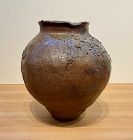
$3,700.00 Tokoname jars were made by piling coils of clay, smoothing the interior and exterior surfaces, and allowing the clay to dry before adding another section. The wide rim and mouth were then formed on a potter’s wheel and added to the top of the jar. The small base allowed the vessel to stand safely on a narrow step on the steep slope of a rising kiln floor; such kilns were built into the side of a hill and used wood for firing...
Zentner Collection
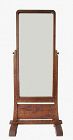
Sold An antique Japanese Kyodai (mirror stand) made of Toneriko (Tamo Ash) and Tochonoki (Horse Chestnut) woods. Original bronze fittings and finish. The bottom support panel features a relief hand carving of a flying crane, a sea turtle, a pine tree and bamboo, all good luck symbols representing longevity and strength...
Japanese : Tea Articles : Pre 2000
item #1421757
(stock #TRC230923)
Kyoto Ceramics and Fine Art
$4,750.00 A truly unique work of Shino pottery developed among the company of some of Japan’s most respected and influential potters of the last century. Defying conventions of form and genre, this exceptional mizusashi looks like it could have emerged from the ground fully formed, the result of geological processes lasting millennia. The creator of this fine work is none other than Tsuboshima Dohei, a true master of the ceramic arts...
Japanese : Tea Articles : Contemporary
item #1419999
(stock #TRC2060)
Kyoto Ceramics and Fine Art
Sold, Thank You! Imagine the vista of iconic Mount Fuji as you enjoy a cup of matcha from this very special tea bowl...
Japanese : Tea Articles : Contemporary
item #1419845
(stock #TRC250312)
Kyoto Ceramics and Fine Art
$1,750.00 When the founder of the Urasenke style of tea ceremony, Senso Soshitsu (1622 -1697) was invited to Kanazawa as the lord of the tea ceremony for the powerful Kaga lords in 1666, the first Chozaemon came with him and established Ohi-yaki ware in Kanazawa. Chozaemon had been the chief apprentice for the Raku family in Kyoto and took with him many of the principles and ideas associated with Raku-ware...
Japanese : Tea Articles : Contemporary
item #1419115
(stock #TRC2041)
Kyoto Ceramics and Fine Art
Sold, Thank You! This depiction of the eternal “ensō” on a backdrop of pearly white feldspar signifies enlightenment, the eternal, the nothingness, and the freedom of the mind to envision and to create. Wood-fired in a small-batch ana-gama, the techniques used to produce such works stretch back over 500 years and were only recently revived in the first half of the previous century by a dedicated group of artists.
The potter who created this piece (Kato Kozo) was born in 1935 in Gifu prefecture ...
Zentner Collection
$1,875.00 An antique Japanese Katana Tansu known as a sword chest made entirely of Kirinoki (Paulownia) wood. All original finish and hand made iron fittings including the Hirute handles. Construction includes using straight dovetail joinery and hardened wood nails.
Age: Meiji period (1868-1912) Dimensions: 43 3/4" Wide x 12 1/2" High x 12 1/8" Deep
Japanese : Tea Articles : Pre 1700
item #1418859
(stock #TRC2050)
Kyoto Ceramics and Fine Art
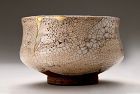
Sold, Thank You! This lovely Shino tea bowl from the Edo period is fashioned from coarse Mino clay and is covered in feldspar glazing. As with many pieces of this period and style, it has classic abstract painting across the sides created using ferrous pigment—contrasting nicely with the ivory background. Not only does this piece have a lovely wabi feel to it bestowed by age; it also has several exquisite gold repairs that contrast nicely with the soft patina and the crackled glazing.
Shino-ware d...
Zentner Collection
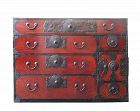
SOLD An antique Japanese Sendai Tansu made of Keyaki (Zelkova) and Suginoki (Cryptomeria) woods. The front features a beautiful finish of natural Urushi lacquer with a top and sides finished in a wiped lacquer technique. The Sendai tansu showcases a wide top drawer lock plate that highlights an incised stylized Chrysanthemum blossom with its corresponding leaves. The Mokko style handles also feature Chrysanthemum back plates. It was constructed using straight dovetail joinery and hardened wood nai...
Japanese : Tea Articles : Pre 1950
item #1418698
(stock #MOR7095)
The Kura
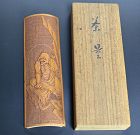
Sold, with thanks! A halo surrounds the emaciated figure of a Rakan (Arhat or Arahat) seated atop a stone draped in billowing robes clutching a nyoi scepter in his bony left fist. The holy figure is chiseled and polished with extreme care and attention to detail. The detail in the carving is striking, as bamboo is notoriously hard and difficult to work. Setting it apart from most bamboo carving is a complex pattern of extremely fine chiseled texture throughout. It comes enclosed in a wooden box signed Raizan and...
|


![An “Imogashira” Mizusashi by Raku IX (Ryônyû) [1756 - 1834]](https://images.trocadero.com/stores/KyotoArt/items/1425178/pict.jpg)