| Home | | | Items For Sale | | | Shops | | | Current Auctions | | | Auction Information | | | Auction Schedule | | | My Vervendi | | | Seller Registration | | | Bidder Registration (free) |
| Directory: Japanese: Tea Articles: Pottery (615) |
|
Auctions Shops Active In This Category
MAIN CATEGORIES
|
Momoyama Gallery
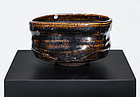
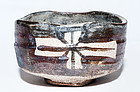
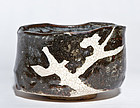
sold Distorted half cylinder shaped (kutsugata) tea bowl made of little iron bearing, coarse, unrefined Mino clay. The expertly thrown body, trimmed with a potters knife (hera) is covered with the typical, glossy black iron oxide inside and outside. Here it is a rarely seen dark brown due to a lack of manganese. A window on the side has been left unglazed for decoration in iron oxide engobe under a clear ash glaze in a form of straight and wavy lines. This is a typical Momoyama design...
Momoyama Gallery
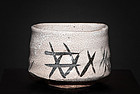
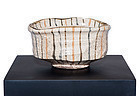
sold Cylinder shaped (hanzutsu) tea bowl made of light, fine unrefined Mino clay. Style (trimmed mouth, very controlled glaze) make it appear contemporary with the late Oribe bowls. The expertly thrown body is covered with the typical white, feldspatic Shino glaze which has been poured and under which a decoration of brush strokes has been applied in iron oxide (oni ita) representing grass and fences. Just the foot ring and its immediate surrounding was left unglazed...
Kyoto Ceramics and Fine Art
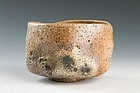
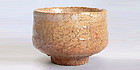
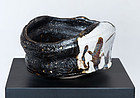
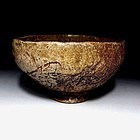
Sold, Thank You! Though this piece appears quite old and nicely worn by time, it is in fact a very recent work from Sekizanjin kiln. Using a special organic process to “ferment” powdered ore used in the clay, they then fire the hand molded pieces under extreme heat to produce bowls they call “Chibori.” The Chibori bowl featured here is inspired by works of Chojiro—forbearer of the Raku line of potters and collaborator with legendary tea master Sen no Rikyu...
Momoyama Gallery
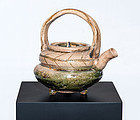
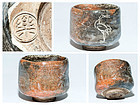
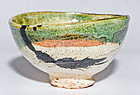
sold Another wonderful tea ceremony item from the late Momoyama / early Edo Period: little distorted gourd (Hyotan) shaped choshi made of little iron bearing, coarse, unrefined Mino clay. The expertly thrown body had roughly formed spout handle and feet attached. The lower part of the body is covered with the typical green copper oxide glaze and the upper part is decorated with lines under glaze in iron oxide resembling the pattern of a feather...
Kyoto Ceramics and Fine Art
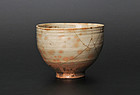
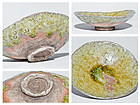
Sold, Thank You! A beautifully formed bowl in the typical Gohon style, produced in Korea for the Japanese market during the 17th century. The light-grey ash glaze makes a tasteful backdrop for the pinkish speckles decorating the surface. These patterns are formed through a reaction of the iron in the clay and the ash glaze and are very typical of this type of pottery. One edge of the bowl is furnished with a dimple, making it comfortable in the hand while the gold repairs give it an added beauty and depth...
Kyoto Ceramics and Fine Art
Sold, Thank You! The creator of this lovely Hagi chawan, Hirose Tanga (b. 1939) is the master-potter of Tenpozan kiln in the city of Hagi. When I acquired this piece I thought it reminded me of bowls produced by Yoshida Shuen (apprenticed under NLT Miwa Kyusetsu). As it turns out, Yoshida worked alongside Hirose in establishing Tenpozan and in training young potters in the art of “oni” Hagi which utilizes a rough textured clay and a milky translucent glaze (like the bowl shown here)...
Momoyama Gallery
sold We proudly present this outstanding Mugi-de Oribe Chawan. Distorted half cylinder shaped (kutsugata) tea bowl with slightly flaring mouth made of light, unrefined Mino clay. The expertly thrown body was trimmed with a potters knife. With the exception of the foot ring the bowl is covered with a clear (wood ash and feldspar) glaze inside and out...
Momoyama Gallery
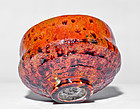
sold Perfect Aka-Raku Chawan by the 10th Kichizaemon Tan-Nyu with its signed authentication box. The Kichizaemon family of potters was established in Kyoto by Chojiro during the Momoyama period (16th century). The 10th. generation head of the family (Tan-Nyu, 1795-1854) was born the second son of the 9th generation Kichizaemon. Along with Yoyosai assisted in the establishment of a kiln for the Kishu branch of the Tokugawa family, and soon followed that up with others around the country...
Momoyama Gallery
sold Another stunning and important cultural highlight of our collection: distorted shoe shaped (kutsugata) tea bowl made of light, fine, unrefined Mino clay. Shape and style make it appear contemporary with the late Oribe bowls...
Momoyama Gallery
sold This magnificent chawan is a perfect embodiment of the Oribe tradition of Japanese pottery by legendary master and modern avangarde artist Suzuki Goro, enclosed in its original signed wood box. He surely needs no introduction. Suzuki is one of those once in 500 years' type of artists. Suzuki Goro is a potter who goes beyond that usual appellation...
Momoyama Gallery
sold Here is a fascinating Oribe Chawan (tea bowl) made by Koie Ryoji, one of the best internationally known contemporary Japanese potters...
Momoyama Gallery
sold Shiny and vivid Aka Raku (Red Raku) Chawan, hand molded during the Meiji Period around 1900. The chawan is signed and the wood box is included, too. Some parts of the chawan were intentionally left unglazed (white parts around the foot - no cracks!) to generate imperfection. Size: 2,9'' height x 4,5 cm in diameter.
Momoyama Gallery
sold Wonderful Shigaraki Hira Chawan with artistic and shiny glaze, made around the end of the 19th century. No cracks or repairs. A real aesthetic chawan. The original wood box and shipping are included. Size: 4,9 cm height x 16,6 (max) in diameter.
Momoyama Gallery
sorry sold Slightly distorted cylinder shaped (hanzutsu) tea bowl made of light, fine, unrefined Mino clay. Shape and style make it appear contemporary with the late Oribe bowls. The expertly thrown body is covered with the typical black oniita engobe inside and outside - with the exception of the bottom - over which a white, feldspatic Shino glaze has been poured. Just the foot ring and its immediate surrounding was left unglazed. The decoration scratched into the iron oxide engobe seems to ...
Momoyama Gallery
sold Special offer: very old Shigaraki Chawan, hand shaped around the early 19th century (Edo Period). It has a great wabi sabi aura without chips, cracks or repairs. A wood box is available for 50 $, a shifuku (silk pouch) for 30 $, box and shifuku together for 60 USD. Size: 7,5 cm height x 12,6 cm in diameter. Shipping included
Kyoto Ceramics and Fine Art
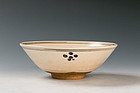
Sold, Thank You! This lovely plum patterned chawan (umebachi) is done in a classic style known as e-Gorai (“e” meaning picture and “Gorai” meaning Korean). This classification is somewhat of a misnomer as the style is said to have first developed at China’s Cizhou kilns in early Ming—only later being widely copied and popularized in Korea. e-Goriai wares first made an appearance in Japan by way of Korea at the end of the 16th century and have been highly appreciated among tea enthusiasts to this day....
Momoyama Gallery
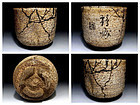
$1,400.00 We kindly like to offer you a very unique tea bowl, made around 1800. Very sophisticated Karatsu Chawan, perfect in form and shape. It presents a real wabi sabi aura with its fantastic lacquer-silver repair and its antique Japanese characters on. The 1st one seem to be Sakura (Cherry), and the 2nd probably Umi (ocean), but they are hard to read. Size: 10 cm height x 10,5 cm in diameter. Shipping included
Momoyama Gallery
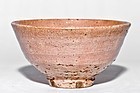
sold Is there a tea ceremony connaisseur, who does not like to have a true Edo Ko-Hagi Chawan with beautiful loquat color?
Take a look on this rounded wan-shaped bowl. The light, sandy clay with enclosures is expertly thrown. Including the foot ring the bowl is covered with a mixed feldspar and ash glaze. The light iron oxide in the clay produded a beautiful loquat color known from Korean Ido chawans. The unrefined clay indicates, that this piece was produced during the mid Ed... |