| Home | | | Items For Sale | | | Shops | | | Current Auctions | | | Auction Information | | | Auction Schedule | | | My Vervendi | | | Seller Registration | | | Bidder Registration (free) |
| Directory: Japanese: Tea Articles: Pottery (615) |
|
Auctions Shops Active In This Category
MAIN CATEGORIES
|
Momoyama Gallery
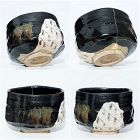
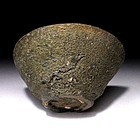
sold It is commonly said that beauty is in the eye of the beholder, yet, in the real world, there seems to be a fair amount of congruity about what people consider beautiful, with most arguments about particular instances being about degree, not direction. This chawan is pure beauty - no matter from which angle you look at it. Slightly distorted cylinder shaped tea bowl with a rounded brim, made of light, coarse, unrefined Mino clay in the early Edo Period around 1620...
Momoyama Gallery
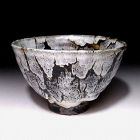
sold Extraordinary Hagi Chawan made by Seigan Yamane. The bowl is covered with a wonderful draft ice glaze. Mint condition. Seigan Yamane was born in 1952, and started making Hagi ware in 1987. And then, he started his own pottery in 1992 and has ever been awarded a lot of prizes for his great work. Size: 9 cm height x 14 cm in diameter. Shipping included...
Momoyama Gallery
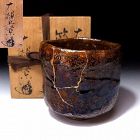
sold We present a stunning Japanese tea bowl made 80 years ago by the legendary 9th Choraku Ohi (1901-1986), enclosed in its originally signed and sealed wooden box. Aesthetic highlight is the perfect kintsugi gold repair, which makes this tea bowl to a unique treasure. Highly recommended for sophisticated collections. The Ninth Chozaemon was the son of the Eigth Chozaemon who had been making tea utencils from age sixteen until his death at age eighty-six...
Kyoto Ceramics and Fine Art
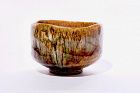
Sold, Thank You! Reminiscent of lines of dripping wax from a candle, the colored ripples streaming down the sides of this tea bowl give the impression of fluidity and transformation...
Momoyama Gallery
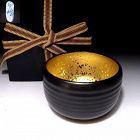
sold Vintage Japanese Tea Bowl of Kyo ware with laquered wooden box. This tea bowl was made around 50 years ago. The inside of the bowl is covered with gold glaze. Very rare. Size: 7,7 cm height x 10,8 cm in diameter. Shipping included.
Kyoto Ceramics and Fine Art
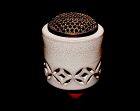
Sold, Thank You! The fine crackled feldspar glazing of this Hagi composition contrasts nicely with the red ferrous clay of the base and the wrought silver globe resting atop. Along the lower half can be seen a geometric windowed pattern giving this incense burner a sense of dimensionality.
Legendary potter Miwa Kyuwa (1885-1981) has been credited with reviving the Hagi tradition of pottery after the war...
Momoyama Gallery
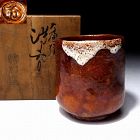
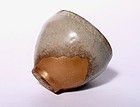
sold This is a wonderful vintage Japanese Raku style tea cup of Ohi ware, which was made about 50-60 years ago. The seal of 'Ohi' is stamped on the bottom. This tea cup has an amazing amber glaze. The original wooden box is also included. Ohi ware has become well known for its use of Ame-gusuri, or amber glaze. Being a Raku style, it was low-fired and is quite light and soft in the hands...
Momoyama Gallery
sold Beautiful half cylinder shaped (hanzutsu) tea bowl from the early stage of the Edo Period (1603 - 1868) with a rounded brim, made of iron bearing, coarse, unrefined Narumi Mino clay. The expertly thrown body was trimmed with a potter's knife in its lower part. The unglazed foot is relatively large...
Kyoto Ceramics and Fine Art
Sold, Thank You! This piece features a warm golden crackled glaze with several patches of lighter pigmentation and a number of gold and silver repairs. The inside of the bowl is especially inviting, showing a magnificent patina developed over many decades of use...
Kyoto Ceramics and Fine Art
Sold, Thank You! The name “Tobe-ware” first appeared in historical documents in the mid-18th century, though the tradition itself dates back well over 1,000 years. Within this style can be found an abundance of fine porcelain and celadon works as well as works painted with dark ferrous glazes—such as the piece featured here.
The creator of this fine work Sakai Yoshito (b. 1931) has been the main figure in maintaining the Tobe-ware tradition in modern times...
Kyoto Ceramics and Fine Art
Sold, Thank You! A very interesting chawan (tea bowl) from the Korean Joseon period (Richo in Japanese; 1392-1897). This particular piece appears to date from the 15th/ 16th century and comes with what may be the original box and a quite old silk pouch. The light creamy crackled glaze is smooth in the hand and fine hairline fractures radiating along the walls of the bowl show remnants of gold repairs from previous centuries...
Momoyama Gallery
sold Beautiful and slightly distorted masterpiece Mizusashi (water jar for tea ceremony) of dark Seto yaki with black and brown glaze. Around 1900, Meiji Period. No chips, no cracks. Size: 18 cm height x 13 cm diameter on top. Shipping included
Momoyama Gallery
sold Wonderful and definitely rare Iga Chawan with aesthetic kintsugi gold repair. This chawan was made approx. 200 years ago during the Edo Period...
Momoyama Gallery
sold Here is one of the most important chawans of our collection: rounded wan shaped tea bowl with high foot of the bamboo node style in the typical O-Ido shape. The light, little coarse clay with enclosures is expertly thrown and full glazed - with the exception of the foot - with a transparent glaze of wood ash with some feldspar over a white engobe - in the style of Korean kohiki chawan (unglazed area on the outer wall is a typical feature found on many kohiki chawans). The glaze sho...
Kyoto Ceramics and Fine Art
Sold, thank You! Signed by the 13th Iemoto (tea master) of Omotesenke, Sokuchusai (1901-1979) this exceptional tea bowl bears the poetic name Asahi or “Morning Sun.” Brilliant ochre and ash hues highlight molten swirls and dynamic features. This bowl has exceptional keshiki, or “ceramic landscape.“
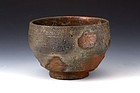
Bizen’s distinctive and easily recognizable style originated in Okayama (south-western Japan) and has a long history. It is well-known as one of the 6 ancient Japanese kilns, established over a...
Momoyama Gallery
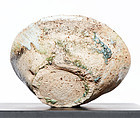
sold Japanese Tokoname Yama Chawan (literally 'Mountain Tea Bowl'), biscuit firing ware with impressive natural glaze and slightly distorted form. It dates back to the Kamakura Period (1185 - 1333). Size: 4 cm height x 15,6 cm (max) in diameter. Shipping included
Momoyama Gallery
sold Wonderful hand-shaped Shino Chawan by great To-en Miyamura, made around 1935, enclosed in its origninally signed and sealed wooden box. Smooth and very aesthetic Shino glaze and a true wabi-sabi aura. No chips or cracks. Impressive feeling holding this big tea bowl in your hands. Size: 8,5 cm height x 11,5 cm in diameter. Shipping included.
Kyoto Ceramics and Fine Art
Sold, Thank You! The gray-blue celadon displays finely crackled glazing with areas slightly darkened by time. A faint pattern made of white inlay can be seen along the upper rim, complimented in several areas by antique kintsugi repairs. The maki-e gold repair at the base—with its design of half waves and half flowering vines—though quite old, seem not quite so old as the repairs along the rim. The small delicate kodai (foot) supports this fine work with grace and effortlessness.
Though the exac... |