| Home | | | Items For Sale | | | Shops | | | Current Auctions | | | Auction Information | | | Auction Schedule | | | My Vervendi | | | Seller Registration | | | Bidder Registration (free) |
| Directory: Japanese: Paintings (1057) |
|
Auctions Shops Active In This Category
MAIN CATEGORIES
|
Zentner Collection
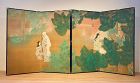
Price on Request Framed beneath a slender sapling, a wispy figure kneels at the shrine steps hands together in prayer. Beautifully painted details performed with thick pigments on silk. Darkening Cedar trees naturally frame the calming scene. Condition is excellent and ready to display.
Signed Kuniyama (Kokuzan) Possibly the work of Higashiyama Kuniyama (elder brother of the famous artist Higashiyama Kai) Taisho Period (1912 - 1926) Dimensions: 69" High x 68" Wide (each)
AfricAsia Primitive and Antiques
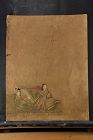
€250.00 Pair of ancient paintings on paper, with polychrome colours and gold. The first painting represents a noble lady, in formal attire, sittings on an elevated platform. Two characters are painted at the back. This painting is partly folded, the paper is stained due to age and has suffered three insect attacks. The second painting represents a noble man in formal attire and sitting on an elevated platform. Two characters are painted at the back...
Hawkes, Asian Art
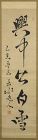
~~~SOLD~~~ A kakemono presenting an example of calligraphy by Shunsui Rai, 1743 ~ 1813. Shunsui was a Confucian scholar of some influence in the Hiroshima district and an historian. He is the father of Sanyo Rai, 1781~1832, who also became a notable calligrapher and a painter and scholar.
Overall the dimensions are 170cm x 36cm. The picture size is 91cm x 25cm. The scroll ends are rosewood. Good condition overall with just minor horizontal creases noted...
Zentner Collection
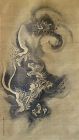
SOLD Large Japanese antique sumie dragon flying in clouds scroll. Exuberantly painted on silk with lovely splashes of ink. Brown brocade mounting. Good condition. Signed and sealed signed Hōgen Nyosen, one of the names used by Kanō Chikanobu (1660-1728), a leading Kano-school painter of the eighteenth century Edo. (Hōgen means "dharma eye" and Nyosen means "river-like")...
Zentner Collection
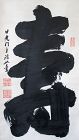
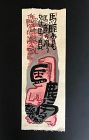
Price on Request Large Japanese Zenga calligraphy scroll of the character 'KOTOBUKI', or long life, longevity. Bold, large brush strokes showing great intensity. Signed and sealed with three red seals by the artist. Small black kanji translates with the first 4 characters: 日光門主 Nikkō Monzu, who was a very high-ranking monk of imperial lineage at the temple, Rinnō-ji, in Nikkō.
The seals used by monk show his rank and importance...
The Kura
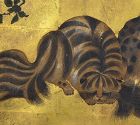
sold, with thanks! A pair of small gold doors depicting Asian Civets (Jakoneko) in a flower strewn garden dating from the early to mid Edo period (17th to 18th century) reminiscent of the famous pair of screens heralding the same image by Kano Yukinobu (Utanosuke, active Muromachi period). The handmade bronze handles are in the shape of hollyhock leaves, intimating connection to the Tokugawa clan, head of the Shogunate...
The Kura
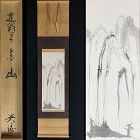
Sold, with thanks! Scratches of ink form a precipitous landscape of jagged mountains on the paper surface of this scroll performed by Fujii Tatsukichi enclosed in a wooden box titled: Painted by the elder Tatsu, One Scroll, Mountain, Annotated by Eichi. It is framed in a silk border terminating in black lacquered rollers. It is 13-1/2 x 59 inches (34 x 149 cm) and is in excellent condition.
Kato Eichi (1899-1987) was a potter from Seto who trained under Tatsukichi...
The Kura
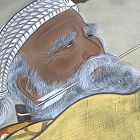
sold, with thanks! The village headman aims his arrows at the moon to dispel the evil brought on by a solar eclipse, the village women in the background standing in prayer. This scene was painted by Higuchi Tomimaro for show at the Seikosha Exhibition held in Osaka in 1938. It is an excellent look into the world of the Ainu, a native culture to Northern Japan now lost to history...
Zentner Collection
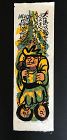
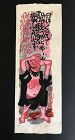
$600.00 A woodblock print by the artist Karhu. The print is labeled "Wealth & Happiness". The full narrative is "Wealth & Happiness come to Those Who Don't Deserve Them". Clifton Karhu became one of the most successful contemporary Western artists working in Japanese woodblock style.
Karhu lived permanently in Kyoto, Japan, where he was the head of the Kyoto branch of the renowned Japan Print Society...
Zentner Collection
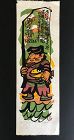
$600.00 A woodblock print by the artist Karhu. The print is labeled "Fish of Fortune". The full narrative is "Don't Let Go of the Fish of Fortune". Clifton Karhu became one of the most successful contemporary Western artists working in Japanese woodblock style. Karhu lived permanently in Kyoto, Japan, where he was the head of the Kyoto branch of the renowned Japan Print Society. Print is signed and numbered 41/100
Date: 1976
Dimensions: 26" X 8.25"
Zentner Collection
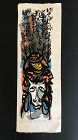
$600.00 A woodblock print by the artist Karhu. The print is labeled "Hurry to Study". The full narrative is "Hurry to Study wih Age the Spirit Slows". Clifton Karhu became one of the most successful contemporary Western artists working in Japanese woodblock style. Karhu lived permanently in Kyoto, Japan, where he was the head of the Kyoto branch of the renowned Japan Print Society. Print is signed and numbered 12/100
Date: 1976
Dimensions: 25.75" X 9"
Zentner Collection
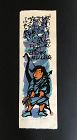
$600.00 A woodblock print by the artist Karhu. The print is labeled "Negligance". The full narrative is "Fight the Enemy, Negligance". Clifton Karhu became one of the most successful contemporary Western artists working in Japanese woodblock style. Karhu lived permanently in Kyoto, Japan, where he was the head of the Kyoto branch of the renowned Japan Print Society. The print is signed and numbered 23/100.
Date: 1976
Dimensions: 25.75" X 8.25"
Zentner Collection
$600.00 A woodblock print by the artist Karhu. The print is labeled "Bigger Fool". The full narrative is "The Bigger Fool is a Fool Who Hires a Fool". Clifton Karhu became one of the most successful contemporary Western artists working in Japanese woodblock style. Karhu lived permanently in Kyoto, Japan, where he was the head of the Kyoto branch of the renowned Japan Print Society. The print is signed and numbered 37/100
Date: 1976
Dimensions: 24.5" tall X 9" wide
Zentner Collection
$600.00 A woodblock print by the artist Karhu. The print is labeled "Avoiding Stepping". The full narrative is "As You Would Avoid Stepping In Shit, Ignore Fools". Clifton Karhu became one of the most successful contemporary Western artists working in Japanese woodblock style. Karhu lived permanently in Kyoto, Japan, where he was the head of the Kyoto branch of the renowned Japan Print Society. Print is signed and numbered 17/100
Date: 1976
Dimensions: 26" X 9.25"
Zentner Collection
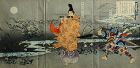
$5,000.00 A Japanese Tsukioka Yoshiyoshi (1839-1892) tryptch "Toin no Akinotsuki" from the "Legend of the Hero and Warrior" series. Autumn Moon at Toin: Flute Player Yasymasa.
Date: 1894 Dimensions:13.25"h x 27.25"w
The Kura
sold, with thanks! The golden orb shines out like the light of Buddhism from between the dark clouds on this exquisite 19th century image by Wada Gozan, priest of Jinko-in Temple. Ink and gold-pigment on silk in a patterned silk border with wood rollers in a period kiri-wood box titled Tsuki no ga Yokomono Ippuku (1 wide painting of moon) Wada Gozan koto (of Wada Gozan), annotated by Kuten. It is 25 x 48-1/2 inches (63.5 x 123.5 cm) and is in overall fine condition, with a minor wrinkle in the lower border...
Zentner Collection
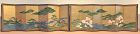
Price on Request A rare pair of original Japanese six panel screens depicting the four seasons of Ginza. The panels are painted in the traditional Kano school. Using exceptional technique, the images are hand painted with natural rimpa paint and ink and gold leaf ground on gofun paper. The six panels depict the seasonal landscape of a Ginza garden. Excellent overall condition.
Date: Edo Period (Early 19th Century) Dimensions:41 1/2” high X 110 1/2” wide (Each screen)
Zentner Collection
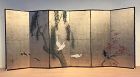
Price on Request An unusual Japanese six panel screen of Ducks, Egrets, and Pheasants. Painted with rimpa paint on an unique mix of gold and silver leaf gofun paper, which gives the screen an incredible look and balance of cold and warm tones, depending on lighting. The painting composition shows influences of natural history and the importance of empty space.
Date: Meiji Period (early 19th Century) Dimensions: 67” high X 147 1/2” wide |