| Home | | | Items For Sale | | | Shops | | | Current Auctions | | | Auction Information | | | Auction Schedule | | | My Vervendi | | | Seller Registration | | | Bidder Registration (free) |
| Directory: Japanese: Folk Art (632) |
|
Auctions Shops Active In This Category
MAIN CATEGORIES
|
Haruko Watanabe
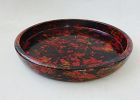
Sold, Thank you. Wood tray with urushi painted whose technique is free and irregular. It might be made not for sale, however, it is unique and interesting. The first half of the 20th century. In good condition except for a few minor chips on the rim.
Diameter:30cm, H:4cm
AntiqueTica.com
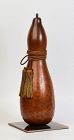
$980.00 Antique Samurai drinking vessel with red lacquer and wooden stopper in excellent condition. The hand made cord tassels complete the set.
Dark old patina due to its age enhances its historical beauty. The sake gourd was a common attribute of the Samurai, it was traditionally attached to the waist by a cord. In Japan, gourd or "hyotan" is a symbol of good luck or success. Symbolic belief of gourd in Japan has existed for a long time...
Haruko Watanabe
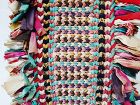
Sold, Thank you. Iwai-Bandori which is a backpack pad for carrying household items on wedding, made in Shonai region in Yamagata prefecture in Tohoku. It is made of cotton rags. In good condition. The first half of the 20th century. L:110cm, W:28cm
Lilly Parker Antiques, Inc.
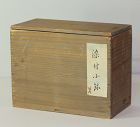
$25.00 Japanese Kiri Wood Old Storage Box, divided 2 sections inside, outside box(8 3/4" x 4 1/4", 7" high, inside each size(3 3/4" x 4 1/8", 6 1/4" high), in good condition.
Lilly Parker Antiques, Inc.
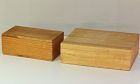
$30.00 Two(2) Japanese Kiri Wood Storage Boxes, old meiji period, larger box(9 3/8" x 7 3/8", 3" high), smaller(7 1/2" x 4 1/2", 2" high, both boxes are in good used condition.
Welcome To Another Century
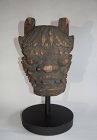
P.O.R. A large mask in the form of the face of an oni (demon) that typically would hang in the kitchen or in a temple, to ward off evil spirits. A slit in the back is for hanging the mask from the wall.
Wood with remnants of polychrome pigments red, white and grayish black. Japan, late Edo period (18th/19th century). H mask 13 in.; H with stand 18.5 x W 9.75 in. Mounted on a stand, sitting on a pole that has been inserted through the chin of the mask...
Haruko Watanabe
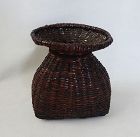
$220.00 Biku, fishing basket, used by a fisherman in rivers. It is made of bamboo strips and urushi painted. It has a cord made of bast fiber. Some spaces between bamboo strips, but no break. in good condition. The first half of the 20th century. H:24cm, W:22cm
Haruko Watanabe
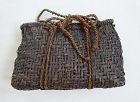
$650.00 Basket handmade of Yama-budo, wild grapevine which grows deep in the mountains. It is used by a mountain worker as a backpack. Generally in good condition but has a few minor breaks. The first half of the 20th century. W:43cm x 28cm x 15cm.
t a t a m i
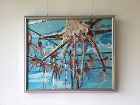
$350.00 SUN-DRIED OCTOPUS A masterpiece of 'Chigiri-e' (ref. https://en.wikipedia.org/wiki/Chigiri-e) as Japanese traditional paper collage to rip and paste paper with only hands with no tool. Titled "Got many friends.", made by Miyashita Akiko, circa late 1990s - early 2000s, Metal frame: 78.5 x 66 x 6 cm (30.90 x 25.98 x 2.36in). In very fine condition...
t a t a m i
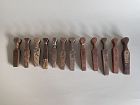
$350.00 TOOL LIKE MORTISE-SAMPLE Details and usage really unknown, but would be a sort of old Japanese architectural wooden tool, like size or form sample of mortise (for mortise joint with a combination of mortise and tenon). Happy first encounter, very rare find. Showa period, early-mid 20th century. Large: 14.5 x 2.5 x 3cm (5.70 x 0.98 x 1.18in), Small: 11.5 x 2.5 x 2.5cm (4.52 x 0.98 x 0.98in)...
Haruko Watanabe
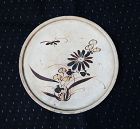
$250.00 Andon-sara which is a bobeche to receive oil in "andon", a paper shade lamp. It is made in Seto in Aichi prefecture, which is one of major six old kilns in Japan. It has hand-drawn flowers and a butterfly design. 19th century. In good condition. Diameter:22cm, H:1cm
Haruko Watanabe
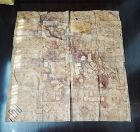
Sold, Thank you. A carpet made of recycled washi fragments which were daifukucho (merchant's record book) or letters, and kakishibu (persimmon tannin) painted for strength and waterproof. It was generally put over tatami mats protecting
them from sun beam or dust. It has letters "Kanei 6 (1853)", very late Edo period. It has rips, holes and moth bites. 204cm x 192cm
Haruko Watanabe
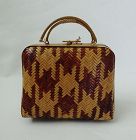
Sold, Thank you. A tiny handbag handmade of bamboo strips. It is all handmade of bamboo, such as body, handles and clasp. Generally in good condition but has two tiny holes in the corners in the bottom. The first half of the 20th century. W:17cm, H:13cm, D:9cm
Kodo Arts
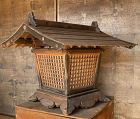
$880.00 Wabi - sabi Japanese Ryokan entrance way wood lamp from the end of the Taisho Period ca. 1930.
Each side with fine shoji lattice work. H: 17"; W: 15"; depth:14". Ask for shipping quote.
Petrie-Rogers Gallery
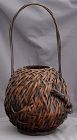
$350.00 Japanese Meiji to Showa period oval form ikebana basket (hanakago) hand-woven from reddish bamboo with natural gnarled wood branches incorporated. Four strips rise from each side of the shoulder and are twisted together to form the high loop handle. Round mouth and base. 18” high with handle (9 1/4" high excluding handle); about 10” diameter. Late 19th to early 20th century. Very good overall condition with minor wear. From a Scottsdale, Arizona estate.
t a t a m i
$280.00 WOODEN CANDY MOLD AND HOW-TO BOOK ON SWEETS Set of wooden mold for making rakugan (hard candy) from Showa period, mid 20th century, and illustrated book for how to make various types of sweets from Taisho 2 as 1913. The mold had been actually used at that time. The book is written well-detailed contents including the guide for use of materials or retail price, etc...
Haruko Watanabe
$100.00 Tatougami which was used at the pawnshop for wrapping pawned items. The name of the shop is "koyama Shichi-ten" and it has the shop's logo "小" in the square. It is a few layers of old washi (handmade paper) pasted together and painted with kakishibu (persimmon tannin) for strength and waterproof. Shichiya (pawn shop) appeared in Kamakura period and developed much in Edo period. 19th century, however one of mending paper has letters "Taisho 4 (1916). Top:87cm x 32cm, Bottom:75cm x 32cm
Haruko Watanabe
$110.00 Tatougami which was used at the pawnshop for wrapping pawned items. The name of the shop is "koyama Shichi-ten" and it has the shop's logo "小" in the square. It is a few layers of old washi (handmade paper) pasted together and painted with kakishibu (persimmon tannin) for strength and waterproof. Shichiya (pawn shop) appeared in Kamakura period and developed much in Edo period. 19th century. Top:82cm x 32cm, Bottom:82cm x 56cm
|