| Home | | | Items For Sale | | | Shops | | | Current Auctions | | | Auction Information | | | Auction Schedule | | | My Vervendi | | | Seller Registration | | | Bidder Registration (free) |
| Directory: Japanese: Ceramics (2435) |
|
Auctions Shops Active In This Category
MAIN CATEGORIES
|
Zentner Collection
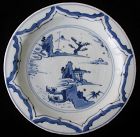
$2,500.00 Porcelain plate made in China for the 17th century Japanese market. Blue and white design of 2 boats in a misty bay with land outcroppings and a mountain pavilion. The underside of the plate is decorated with three thin blue rings and two flowers...
EastWest Gallery
$130.00 .
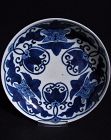
A Nabeshima style dish hand painted with an underglaze blue “karahana” pattern. The reverse decorated with Shippo-tsunagi, six coins bound with trailing ribbons to the reverse and a comb pattern to the foot. The dish measures 18.5cm in diameter (six suns) and stands 4.5cm high. The foot-rim measures 8.6cm in diameter and is 1.2cm high. The dish is in good condition no cracks, chips or restoration...
EastWest Gallery
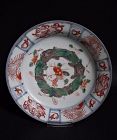
Sold A rather unusual export dish decorated with a Kraak style border of six larger panels containing respectively a pair of Peaches, symbols of Longevity, and a scroll and whisk, representative of the Eight precious objects, Baxia, with the smaller intermediate panels decorated with a combined clove and jewelled Rhinoceros horn motif...
EastWest Gallery
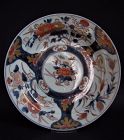
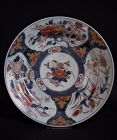
Sold A large plate decorated in the three colour sancai palette with a central Peony motif with three reserves one with Peonies, emblematic of Spring, a pair of Quails beneath Millet and another with Chrysanthemums, emblematic of the months of Autumn. The partially ogee form reserves set against a blue brocade ground with stylised Chrysanthemums. The reverse decorated with three Peony sprigs. A three spur marks in a triangular arrangement to the base...
EastWest Gallery
Sold A large plate decorated in the three colour sancai palette with a central Peony motif with three reserves one with Peonies, emblematic of Spring, a pair of Quails beneath Millet and another with Chrysanthemums, emblematic of the months of Autumn. The partially ogee form reserves set against a blue brocade ground with stylised Chrysanthemums. The reverse decorated with three Peony sprigs. A three spur marks in a triangular arrangement to the base...
EastWest Gallery
Sold A large plate decorated in the three colour sancai palette with a central Peony motif with three reserves one with Peonies, emblematic of Spring, a pair of Quails beneath Millet and another with Chrysanthemums, emblematic of the months of Autumn. The partially ogee form reserves set against a blue brocade ground with stylised Chrysanthemums. The reverse decorated with three Peony sprigs. A single spur to the base...
Modern Japanese Ceramics
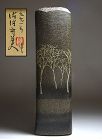
sold, thank you! A tall squared vase inlayed with the silhouette of trees against the evening sky by Saeki Moriyoshi enclosed in the original signed wooden box titled Zogan Jumoku Moyo Kabin and dated 1991. This artists fascination with trees against the sky is inspiring. He has chosen to imbue his works with memories of the perfect sunset, with an autumn morning or late afternoon in winter. This piece is quite large, 18 inches (45.5 cm) tall and in excellent condition...
Zentner Collection
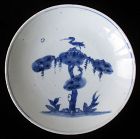
$2,500.00 Porcelain plate made in China for the 17th century Japanese market. Blue and white design of a bird in a pine tree draped in moss. Encircled with a thin ring of blue. The edges of the plate and the many small irregularities in the firing are especially prized in this type of ware.
"Ko-sometsuke ('old blue and white') porcelain was produced specifically for the Japanese market during the final decades of the Ming dynasty (1368-1644)...
Modern Japanese Ceramics
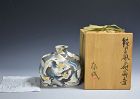
Sold, thank you! Mottled clay in lively matt colors blends on this square bottle by Living National Treasure Matsui Kosei enclosed in the original signed wooden box titled Fuhakuji Henko. It is 12 x 15 x 13 cm (4-3/4 x 6 x 5-1/4 inches) and in excellent condition.
The Kura
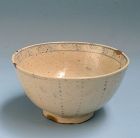
sold, thank you! An Annan pottery tea bowl for use in the Japanese tea ceremony from the kilns of 15th-16th century Vietnam enclosed in an age-blackened kiri-wood box. The crackled pale glaze is decorated with a band of blue frets about the rim inside, a decidedly modern design of droplets descending in beads down the outside typical of early Vietnamese decoration...
Kyoto Ceramics and Fine Art
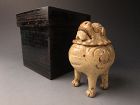
Sold, Thank You! Considered an auspicious symbols of wealth, status, and good fortune, foo dogs—commonly referred to as shishi or komainu in Japan—are often seen in pairs guarding shrines, straddling the doorways of shops, and protecting public buildings. The yellow Seto-ware shishi featured here is an antique from the Momoyama period that displays a soft patina developed over many decades of use...
Modern Japanese Ceramics
Sold, thank you! A delightful small tea bowl by one of the greatest potters of the 20th century, Kamoda Shoji, enclosed in a wooden box signed by his wife. Brown glaze is draped quietly across the rough dark clay, the contrast between simplicity and texture a pleasure to hold. It is 4 inches (10 cm) Diameter, 2-1/2 inches (6.5 cm) tall and in excellent condition.
Kamoda Shoji is without a doubt one of the most important and influential ceramic artists of the 20th century. Born in Osaka in 1933, he stud...
Zentner Collection
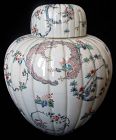
SOLD Rare Japanese kakiemon ware porcelain jar. Of a tapered melon shape, with circular floral enso motifs of bamboo, blossoming cherry branches, hydrangea, kiri leaves. The Imperial dragon and phoenix paired to represent the emperor and empress. With overglaze green, red, and blue on white bisque ground. The domed lid topped with karakusa (octopus vine) and kiri leaf pattern.
19th century Dimensions : 7.5" W x 10" H
Modern Japanese Ceramics
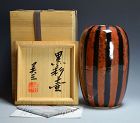
Sold, thank you! A striking black and orange striped vase in simplified ovoid form by Mukunoki Eizo enclosed in the original signed wooden box titled Kokusai Tsubo. This was purchased at a Mitsukoshi Exhibition. It is 8 inches (20 cm) tall and in excellent condition.
Mukunoki Eizo Born in Shimane, and graduated the prefectural ceramics research facility before he apprenticed under Kawai Kanjiro in 1958. He would stay with Kanjiro until the masters death in 1966. To show respect and mourning for his sen...
EastWest Gallery
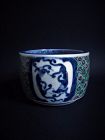
$280.00 A koro of rounded barrel shaped profile decorated with a repeating pattern of underglaze dragons, chilong, framed by rectangular shaped reserves constructed from c form scrolls set against a pine scale ground painted in aubergine, green and yellow enamels. The lip of the rim painted in blue and the interior of the rim painted with a diaper band. The koro dates to the late mid Edo period c.1750-80.
It measures approximately 12.5cms in diameter (12cm at the rim), and stands 8cms high with a reces...
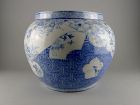
Large and heavily potted porcelain body, decorated in an nice pale cobalt blue in Shunzui style and with medallions showing flying birds and wild gees, birds sitting on branches, sailboats and Fujiyama mountain.
Japan, nineteenth century.
Diameter: 42 cm. H : 33 cm.
Condition: Broken at one area to the rim. This broken area would be absolutely suitable to ennoble the piece with a most beautiful Kintsugi repair ( Gold lacquer repair, please see the images ).
EastWest Gallery
Sold
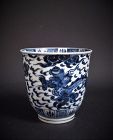
A tall beaker of bell form decorated in underglaze blue with a pair of auspicious Dragons each clasping a “tama” pearl above its head set against a lightening field with auspicious ruyi form clouds supporting respectively artemesin leaves on which are a pair of scrolls bound by ribbons and a flaming pearl.
The design has been adapted from a Chinese precedent of the sixteenth century but with a Japanese twist to the design. The fierce Chinese Dragons have been replaced with benign Buddh...
EastWest Gallery
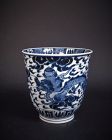
Sold A tall beaker of bell form decorated in underglaze blue with a pair of auspicious Dragons each clasping a “tama” pearl above its head set against a lightening field with auspicious ruyi form clouds supporting respectively artemesin leaves on which are a pair of scrolls bound by ribbons and a flaming pearl.
The design has been adapted from a Chinese precedent of the sixteenth century but with a Japanese twist to the design. The fierce Chinese Dragons have been replaced with benign Buddhist...
|