| Home | | | Items For Sale | | | Shops | | | Current Auctions | | | Auction Information | | | Auction Schedule | | | My Vervendi | | | Seller Registration | | | Bidder Registration (free) |
| Directory: Chinese: Antiquities (1418) |
|
Auctions Shops Active In This Category
MAIN CATEGORIES
|
Brian Page Oriental Art
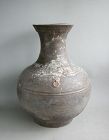
GBP £1,650 LARGE Chinese Han Dynasty Burnished Pottery Hu Jar with Oxford TL Test (206 BC - AD 220)
This unusually large and imposing pottery jar, or "hu" was made during the Han Dynasty (206 BC - AD 220). It is made from a fine-grained grey pottery that is relatively highly-fired. This is an exceptional example of its type of fine form with its wide body and tall neck that flares inwards and then out again to the wide mouth...
The Oriental Room
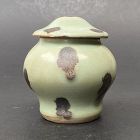
SOLD A Chinese Longquan Celadon Jar with Iron-Spots. Circa, 14th Century, Yuan Dynasty.
Found in the Philippines.
Featuring a small ovoid shaped body, topped with a flat rounded cover and is covered overall in a green celadon glaze with iron-brown spots, except for the foot-ring.
Measurements: height (3.5'inches).
Condition: there is a very small rim frit on the jars mouth but is overall in very impressive condition. No cracks, no restorations...
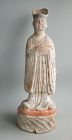
Large Chinese Tang Dynasty Painted Pottery Figure
This large and impressive pottery figure represents an official or a dignitary and was made during the Tang Dynasty (AD 618 - 906). It is made from a high-fired buff-coloured pottery that has been cold-painted in a base coat of a creamy-white pigment with details picked out in red, pink and black pigments. The figure stands upright on an integral pedestal wearing a long flowing robe under which his hands are held together across his chest...
The Oriental Room
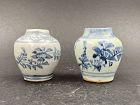
SOLD A Similar Pair of Chinese Blue and White Miniature Jars. Circa, 1464-1505, Chenghua-Hongzi, Ming Dynasty.
Found in the Philippines.
Featuring two miniature jars with an underglaze floral decoration in between borders. Fully unglazed bases.
Measurements: height (2.8"inches).
Condition: in perfect conditon...
The Oriental Room
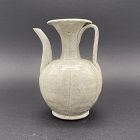
SOLD Found in the Philippines.
Featuring a rounded melon shaped body and a waisted neck that flares to its mouth with a curved spout, opposite an applied flat handle and is covered overall in a green-white 'qingbai-type' glaze, except for the base which remains fully unglazed...
The Oriental Room
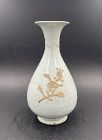
SOLD A Chinese White Glazed Yuhuchunping Vase with Flowers in Biscuit. Circa, 1368-1644, Ming Dynasty.
Found in the Philippines.
Featuring a pear shaped body rising from a short straight foot, tapering to its shoulders onto a long waisted neck and flaring out to its mouth. The vase is adorned with cloud patterns and flowers in biscuit and is covered overall in a white glaze, except for the foot-ring.
Measurements: height (11.5"inches).
Condition: in perfect condition...
The Oriental Room
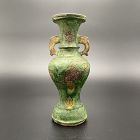
SOLD A Chinese Three-Colored Chi-Eared Vase. Circa, 1505-1521, Zhengde, Ming Dynasty.
Found in the Philippines.
Featuring a baluster shaped body, tapering to its shoulders onto a waisted neck and a flanged mouth with two ear-handles. The vase is carved with a floral decoration and is covered in a green glaze with yellow and brown. Its base remains fully unglazed...
The Oriental Room
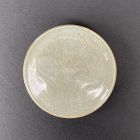
$800.00 A Chinese Celadon Glazed Covered Box. Circa, 10th Century, Yue Ware, Northern Song Dynasty.
Found in the Philippines.
Stoneware covered box with a carved and combed floral decoration. It is covered overall in a grey-green celadon glaze, except for the foot-ring and base.
Measurements: diameter (4"inches) across.
Condition: in perfect condition. No cracks, no chips, and no repairs...
The Oriental Room
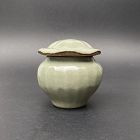
SOLD A Chinese Ribbed Celadon Jar and Cover. Circa, 14th Century, Yuan Dynasty.
Found in the Philippines.
Featuring a ribbed ovoid shaped body, topped with a rounded cover with undulating edges. It is covered overall in a green celadon glaze and its base is fully glazed, except for the foot-ring.
Measurements: height (4.5"inches).
Condition: in perfect condition with glossy glaze...
The Oriental Room
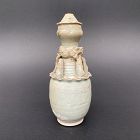
SOLD A Chinese Qingbai Glazed Granary Vase with Cover. Circa, 960-1279, Song Dynasty.
Found in the Philippines.
Featuring a long ovoid shaped body, rising from a short splayed foot, tapering to its shoulders onto a waisted neck with an applied decoration of a dragon above encircling figures and is topped with a conical cover. It is covered overall in a translucent green-white 'qingbai' glaze, except for the base which remains fully unglazed...
The Oriental Room
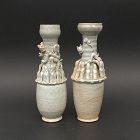
SOLD A Pair of Qingbai Glazed Granary Vases. Circa, 960-1279, Song Dynasty.
Found in the Philippines.
Both vases feature a tall ovoid shaped body, rising from a short splayed foot, tapering to its shoulders onto a long waisted neck and a flanged mouth with an applied decoration of a dragon above encircling figures and both are covered overall in a green-white 'Qingbai' glaze, except for their bases which remains fully unglazed...
The Oriental Room
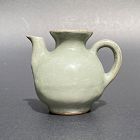
SOLD A Chinese Longquan Celadon Teapot. Circa, 13th-14th Century, Yuan Dynasty.
Found in the Philippines.
Featuring a globular body with a short waisted neck and a curved handle opposite a short spout. The teapot is covered in a green celadon glaze, except for its foot-ring.
A similar example can be seen in the book 'Chinese and Southeast Asian Greenware found in the Philippines' by: The Oriental Ceramic Society of the Philippines, on page: 56;42...
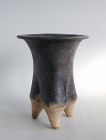
Fine Chinese Neolithic Xiajiadian Culture Burnished Pottery Li Tripod
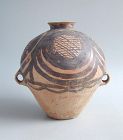
This superb and rare tall pottery vessel was made some 4,000 years ago by people of the Xiajiadian culture (c. 2300 - 1600 BC) from Inner Mongolia. The form of this vessel is characteristic of this Neolithic culture with its wide rim, partly hollow udder-shaped legs and carefully constructed body. The surface of the body above the legs, and the inner mouth, have a finely burnished surface, its smoothness making it a real p... Large Chinese Neolithic Machang Phase Painted Pottery Jar (c. 2300 - 2000 BC)
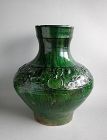
This large pottery jar was made over 4,000 years ago during the Machang Phase (c. 2300 - 2000 BC) of the Majiayao culture, also known as the Gansu-Yangshao culture, from present day Gansu or Qinghai province. The decorative pattern, applied on top of the smooth burnished surface with a fired-on mineral-based pigment, features four roundels containing geometric patterns. On opposing sides just below its waist are tw... Fine LARGE Chinese Han Dynasty Glazed Hu Jar with Hunting Scene
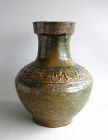
This superb and impressive pottery jar (hu) was made during the Han Dynasty (206 BC - AD 220). It is made from a fairly high-fired reddish pottery and coated in a particularly attractive streaky dark green and finely-crackled glaze, the colour of which varies according to its thickness. Interestingly, the drips of glaze to the mouth rim and the pooling of glaze to the flat base show that this jar was fired upside down. The ... Fine Large Chinese Han Dynasty Glazed Hu Jar with Hunting Scene
This fine and attractive pottery jar (hu) was made during the Han Dynasty (206 BC - AD 220). It is made from a fairly high-fired reddish pottery and coated in a very finely-crackled glaze of unusual colour varying in places from green to a yellowish-brown. There are a couple of minor kiln scars to the glaze, quite common with Han glazed pottery. The neck and shoulder are decorated with deeply incised bands between which are ...
The Oriental Room
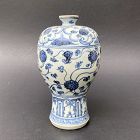
SOLD A Chinese Blue and White Meiping Vase. Circa, 1368-1644, Ming Dynasty.
Found in the Philippines.
Featuring a tapering body supported by a tall splayed foot with a short and waisted neck and is decorated with a band of floral scrolls in between a bordering ruyi pattern with floral sprays and alternating clouds above stylized pattern with a geometrical border.
Measurements: height (10”inches).
Condition: absolutely in perfect condition. No cracks, chips, or restorations.
Photo...
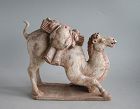
Fine & Rare Chinese Northern Dynasties Painted Pottery Kneeling Camel with Oxford TL Test
This fine and very rare pottery model of a kneeling camel, laden with saddle bags, was made during the Eastern Wei Dynasty (AD 534 - 550) or the following Northern Qi Dynasty (AD 550 - 577). It is made from a pale greyish-brown pottery that is fairly highly-fired. It has been "cold painted" in a base coat of a creamy-white pigment with details picked out in brown, red and black pigments. The camel is i... |