| Home | | | Items For Sale | | | Shops | | | Current Auctions | | | Auction Information | | | Auction Schedule | | | My Vervendi | | | Seller Registration | | | Bidder Registration (free) |
| Directory: Japanese: Tea Articles (1139) |
|
Auctions Shops Active In This Category
MAIN CATEGORIES
|
Momoyama Gallery
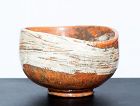
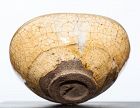
$450.00 Splendid Aka Raku Chawan dating from the later Edo Period (1603-1868). It has a wonderful crazing and a very rare form. Great condition with no cracks or repairs. The chawan comes with a good wooden box. Size: 7,7 cm height x 14 cm in diameter. Free shipping
Momoyama Gallery
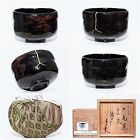
sold One of a kind, a treasure with a special cultural and historical significance.: Kuro Raku Chawan, named 'Departing Geese', by legendary Tamamizu Ichigen (Ichigen I) with perfect kintsugi. Ichigen was an illegitimate son of Kichizaemon Ichinyu (Ichinyu IV). He was raised in the Raku family until he was in late teens...
Japanese : Tea Articles : Pre 2000
item #1376145
(stock #08)
Dragon's Pearl
$1,550.00 A large and stupendous glass vase with a wide mouth decorated with deep, green abstract bands on gold foil by glass artist Tabuchi Koseki (b. 1932). Mouth and bottom with darker bands of deep brownish colour. Signed in the bottom ‘Koseki.’ It comes with fully inscribed, signed and stamped storage box, kiri-tomobako. Japan, late Showa, ca. 1980. H 24 cm, W 24 cm. Condition: Excellent.ÂÂ
Japanese : Tea Articles : Pre 1920
item #1375129
(stock #TRC1858)
Kyoto Ceramics and Fine Art
Sold, thank You! During the Meiji period there were only five potters ever to be awarded the prestigious designation of Imperial Court Artist: Ito Tozan, Seifu Yohei III, Miyagawa Kozan, Itaya Hazan, and the artist whose work is featured here, Suwa Sozan. This mizusashi for tea ceremony is made of the finest “kinuta” celadon that Sozan was well known for—having recreated and perfected the technique used by the Chinese Song Dynasty potters...
Momoyama Gallery
sold Lavender clouds, rain on a foggy morning, snowy mountain landscapes, this is what comes to your mind when you look on this superb pale kurinuki Hagi tea bowl, made by Master and potter legend Kaneta Masanao, enclosed in the original signed wooden box. Kurinuki is a technique carving and scooping out forms from a solid block of clay to produce boldly-cut forms, an approach the artist is famous for. Kaneta Masanao is an 8th generation Hagi potter...
Momoyama Gallery
sold Large and only slightly distorted full cylinder shaped Tsutsu (hight is bigger than diameter) tea bowl with a rounded brim, made of reddish, unrefined Mino clay with clearly visible finger marks on the wall. The expertly thrown body was trimmed with a potter's knife around the regular food ring. In the style of Seto-Kuro bowls this bowl was covered with a black glaze. On three sides a round space was spared from black glaze...
Momoyama Gallery
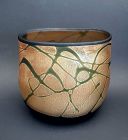
sold Slightly distorted shoe shaped (kutsugata) tea bowl with a rounded brim, made of light, coarse, unrefined Mino clay. The expertly thrown body was trimmed with a potter's knife in its lower part around the foot ring. In the style of Ao-Kuro bowls this bowl was covered with a green copper oxide glaze...
Momoyama Gallery
sold There are only few opportunities to find antique Chosen Karatsu chawans - collectors know of what I'm talking about. Here is the second one of our collection: Chosen Karatsu chawan from the Edo Period. The grandiose embellishment of color creates a sublime sense of tension between the dark glazed and color infusion...
Momoyama Gallery
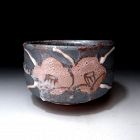
sold The great artist Choraku III made a lot of fantastic chawans - for me this is SURELY HIS BEST: a mysterious Aka Raku Chawan with Buddhist symbols in white slip, which are drawn on the outside of the bowl, slightly deformed and perfectly balanced, definitely one of a kind! With every turn of the bowl, a new face is shown, offering many opportunities for contemplative experiences...
Japanese : Tea Articles : Pre 1800
item #1374422
(stock #TRC19103)
Kyoto Ceramics and Fine Art
Sold, Thank You! A very interesting chawan (tea bowl) dating from the Korean Joseon period (Richo in Japanese; 1392-1897). This particular piece appears to date from the 17th or 18th century and comes with a box that looks to have been furnished within the last 100 years. Over the long history of tea practice in Japan, at varying times, Korean-ware came into high fashion and ships full of the finest ceramics were brought over to Japan...
Momoyama Gallery
sold Elegantly shaped Ki-Seto Chawan from the Edo Period, early 19th century with a rarely seen gold rim. Precious metal rings were added when the chawan was made for the aristocracy and for the high nobility. The beautiful and glossy glaze (guinomi-de) has a fantastic crazing. The bowl has also a decoration with vivid tanpan marks ( copper green marks ). This Ki-Seto tea bowl is in very good condition, very unusual for a chawan of this age...
Momoyama Gallery
sold This magnificent chawan is a perfect embodiment of the Oribe tradition of Japanese pottery by legendary master and modern avangarde artist Suzuki Goro, mint condition and enclosed in its original signed wood box. He surely needs no introduction. Suzuki is one of those once in 500 years' type of artists. Suzuki Goro is a potter who goes beyond that usual appellation...
Japanese : Tea Articles : Contemporary
item #1371916
(stock #TRC18617)
Kyoto Ceramics and Fine Art
Sold, Thank You! One of the more innovative and international minded ceramicists on the Japanese pottery scene, Ryoji Koie’s interests and expertise cannot be confined to one narrow genre—as he often integrates non-traditional methods and materials...
Japanese : Tea Articles : Contemporary
item #1371389
(stock #TRC1836)
Kyoto Ceramics and Fine Art
Sold, Thank You! Ripples of light and dark pigmentation flowing on a background of sky-blue glaze—the description on the box reads 萩孔雀 (Hagi kujyaku) translating as “peacock Hagi” in English. With a distinctive wari-kodai (segmented foot) and unique glaze emulating the vibrant plumage of the notoriously flamboyant bird, this piece leaves a lasting impression.
Born in the illustrious potting town of Hagi, Yamane began his potter’s journey at the age of 35...
Momoyama Gallery
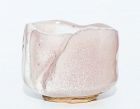
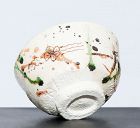
sold Very sophisticated Shino chawan by Japanese artist Ko Ji Nakamura. It has a rarely seen Shino glaze of light pink, grey and blue color, designed with plum blossoms. A really aesthetic bowl which fits the palm of the hands perfectly. This chawan was made around 30 years ago and is well balanced. The seal of his potter name (Kozan-gama) is stamped on the bottom. It is is perfect condition. No chips or cracks. Size: 8,7 cm height x 12,3 cm in diameter.
Momoyama Gallery
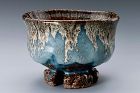
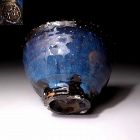
sold Mint and large Japanese pottery tea bowl of Hagi Ware, made by one of the most famous and creative potters of Japan, Seigan Yamane. The blue glaze reminds me always of the colors of universe at night. Stunning! Seigan Yamane was born in 1952, and started making Hagi ware in 1987. He started his own pottery in 1992 and since then he won a lot of prizes for his great work. The special blue on most of his ceramics is called 'Seigan Blue' and was developed in 2002...
Japanese : Tea Articles : Contemporary
item #1369743
(stock #TRC1840)
Kyoto Ceramics and Fine Art
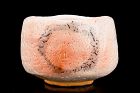
Sold, Thank You! This depiction of the eternal “ensō” on a backdrop of pearly white feldspar signifies enlightenment, the eternal, the nothingness, and the freedom of the mind to envision and to create. Wood-fired in a small-batch ana-gama, the techniques used to produce such works stretch back over 500 years and were only recently revived in the first half of the previous century by a dedicated group of artists.
The potter who created this piece (Kato Kozo) was born in 1935 in Gifu prefecture ...
Japanese : Tea Articles : Pre 1920
item #1369742
(stock #TRC1832)
Kyoto Ceramics and Fine Art
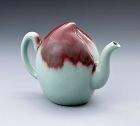
Sold, thank You! This peach-shaped suiteki (water dropper for calligraphy) is made of fine kinuta celadon from one of the great masters of the Meiji era—Suwa Sozan. A classic design, the peach is said to represent long-life for mortals and immortality for the gods in asian folklore. According to legend, the moon goddess—a powerful alchemist—can make an elixir from peaches that grow in the garden of the western paradise with miraculous revitalizing properties.
Suwa Sozan the first (1852—1922... |