| Home | | | Items For Sale | | | Shops | | | Current Auctions | | | Auction Information | | | Auction Schedule | | | My Vervendi | | | Seller Registration | | | Bidder Registration (free) |
| Directory: Japanese: Sculpture (525) |
|
Auctions Shops Active In This Category
MAIN CATEGORIES
|
Momoyama Gallery
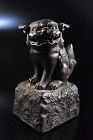
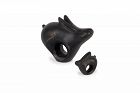
sold A rare late Edo Period (19th cent) Shishi Lion Foo Dog Statue made of iron rich Bizen clay, wood fired in an Anagama kiln. Shishi (or Jishi) is translated as "lion” but it can also refer to a deer or dog with magical properties and the power to repel evil spirits...
GALERIE TIAGO
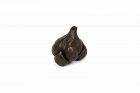
Sold Okimono bronze sculpture of a garlic head with a few cloves visible.
Unidentified mark on the base, most likely from the foundry.
Japan – Meiji era (1868-1912)
Width: 2 in (5 cm) – depth: 1.5 in (4 cm) – height: 1.8 in (4.7 cm)
t a t a m i
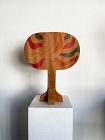
$400.00 BIRD TREE BY SHIGEO FUKUDA Vintage wooden puzzle sculpture toy by Shigeo Fukuda (1932-2009 / https://en.wikipedia.org/wiki/Shigeo_Fukuda), as the same type made for his daughter originally. 1965-1969, Japan. H 27 x 21 x 9 cm (10.62 x 8.26 x 3.54in)...
Zentner Collection
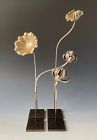
$3,800.00 Antique Japanese set of four lotus leaves and blossoms. Carved of wood and lacquered silver. Made for a Buddhist altar, these leaves and blossoms symbolize the stages of the path toward enlightenment. Every petal of the lotus flower is carved separately. Each blossom and leaf comes fitted with a custom metal stand so they can be rearranged at will.
Age: Taisho Period Dimensions: approx 24"hight (tallest leaf)
Zentner Collection
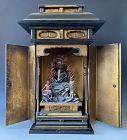
$6,000.00 An antique Japanese zushi (small Buddhist shrine) with Fudo Myo-o and attendants. One of the five myo-o or Lords of Light, Fudo Myo-o sits with sword in hand, the flames of his nimbus swirling around him. Fudo's name means "the unmovable or unshakable one". He is a fierce deity who guards the Law of Buddhism from the forces of evil.
Carved of wood, colorfully painted and with gold and black lacquer. Age: Edo Period (c...
Zentner Collection
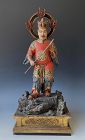
$6,500.00 Antique Japanese carved Buddhist figure with flaming nimbus, standing on a rock in noble garb and holding a sword. Carved of wood, painted with bright colors and gold details.
Age: Edo Period Dimensions: 20 1/2" high x 9 1/2" wide x 6 1/2" deep
Zentner Collection
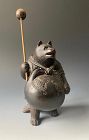
$2,500.00 Japanese antique carved boxwood figure of Soko-tanuki. Here he is disguised as a monk with a large temple bell. The story goes that a tanuki (who is famous for his shapeshifting abilities) worked in the temple for many years. One day while he was taking a nap, he was caught in his original form...
Zentner Collection
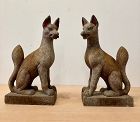
SOLD Pair of antique Japanese Inari foxes hand carved out of granite stone. Each has traces of the original mineral pigment.
Also called zenko, these good spirit kitsune (foxes) are specifically associated with the goddess, Inari.
Believed to be both messengers and guardians, kitsune served Inari in her role as goddess of agriculture, specifically rice. Part of the folklore surrounding the fox is it’s ability to shape shift into human form...
Zentner Collection
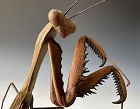
SOLD Contemporary Japanese praying mantis. Hand molded high grade leather over resin. Upright in a boxing position, head alert with watchful eyes. Well detailed.
The stealth movements of the praying mantis have made it a symbol of meditation and contemplation. In China, the insect has long been honored for its mindful movements. It never makes a move unless it is certain that is the right thing to do...
Zentner Collection
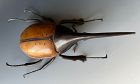
$3,200.00 Contemporary Japanese Rhinoceros (kabutomushi) horned beetle. Hand molded high grade leather over resign form. Highly detailed, supple leather.
Artist specializing in making one example of all types of insects.
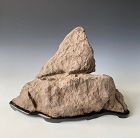
Contemporary Japanese Dimensions: 7 1/2" wide x 4 1/2" high x 14" deep Antique Japanese suiseki on base. Suiseki (sui=water, seki=stone). This natural stone formation resembles a mountain and has pleasing fine quartz striations. It sits on a low wooden base.
Age: Taisho Period (1912-1926) Dimensions: 11 1/8" high x 17" long x 7 1/2" wide
t a t a m i
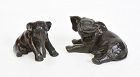
$450.00 STONE INCENSE BURNER FOR THE DEAD Used for memorial service in the hilly area of Miyagi, Tohoku region, since Late Edo period, 19th century. H 13.3 x 21 x 14.5 cm (5.23 x 8.26 x 5.70in)... A pair of Japanese bronze elephants with artist sign.
Age: Japan, 20th Century
The Kura
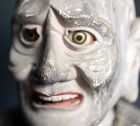
sold, thank you Startled to enlightenment, this is a large Edo period figure of a Rakan (Sanskrit: Arhat), a Buddhist saint kozutsucarved in the Yosegi-zaiku method of joined blocks of wood. Originally covered in polychrome colors, much has grayed and flaked away with time, a fitting aspect of the image. He has glass eyes which seem to burn violently with realization. The image is 43 x 36 x 51 cm (17 x 14 x 20 inches) and is in solid condition. The head is removable, slotted into the body at the collar...
Zentner Collection
Price on Request A symbol of longevity and hope for happiness Minogame temple party headpiece. Gilt gold embossed details over leather hide. The detailed head resembles on of a dragon. Horsehair depicts the long flowing seaweed from the back of the turtle. Condition consistent with age...
Zentner Collection
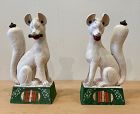
$9,500.00 An original pair of plaster Japanese Inari temple foxes. Crushed oyster shell finish with mineral paint detailing in traditional Shinto colorways : orange, purple, green. Each of the foxes has a soft pink underbelly...
GALERIE TIAGO
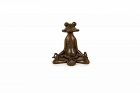
Sold An amusing okimono for use as an incense-burner, in brown patina bronze of an anthropomorphic frog in seated meditation (zazen) or in the lotus yoga position. In the middle of the lotus is a hole for the incense stick.
Representations of this animal in human posture are not uncommon. In the 19th century, the painter Kawanabe Kyôsai (1831-1889) was already depicting frogs in epic battles or everyday scenes. Even earlier, the Chôjû-jinbutsu-giga (lit. "Caricatures of fauna characte...
Pair of bronze rabbits running, their legs forming a round shape.
Made by Hiroharu Hiramatsu (1896 Hyôgo prefecture – 1971, Fukushima,平松宏春). Specialized in metal art, he is a councilor of the Japan Fine Arts Exhibition. He studied with Katsura Mitsuharu (1871-1962), one of the great metallurgists of the modern era. Selected for the first time at the Japan Fine Arts Exhibition in 1934, he has been presenting his work every year, and since then he has been presenting as one...
|